Engine lugging is one of the most common and dangerous driving mistakes in India. Learn what it is, how it damages petrol & diesel engines, symptoms, prevention, and beginner-friendly tips.
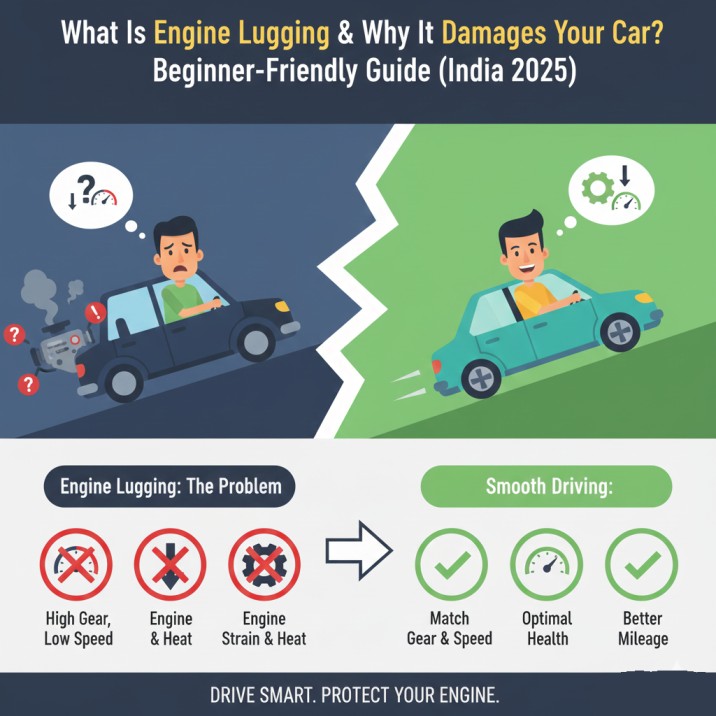
What Is Engine Lugging & Why It Damages Your Car? Beginner-Friendly Guide 🔧🚗🇮🇳 (2025)
Most Indian drivers unknowingly damage their engine daily.
How?
👉 By lugging the engine.
If you drive at very low speed in a high gear, your engine struggles, vibrates, and knocks.
This silent stress eats your engine from inside — reducing life, mileage, and performance.
This guide explains engine lugging in the simplest way possible:
- What exactly it is
- Why it happens
- How it destroys your engine
- Real Indian stories
- How to avoid it
- Petrol vs diesel vs turbo differences
- Practical driving tips
- Early symptoms
Plus, we’ll link related must-read resources across CarInsightHub to help you drive smarter and maintain your car better.
📖 Real Stories – How Engine Lugging Damaged Cars in India
1️⃣ Story: Nitin’s Swift – “Mileage kept dropping and engine sounded stressed”
Nitin often drove at 25–30 km/h in 4th gear to “save fuel”.
Reality?
- Lower mileage
- Rough engine
- Knocking sound
- Early clutch wear
His mechanic diagnosed engine lugging.
Learn mileage-saving the correct way:
How to save fuel in daily driving
2️⃣ Story: Poonam’s Creta Diesel – “Car shuddered every time at low speed”
Diesel engines lug more easily due to higher torque at lower RPM.
She would accelerate from speed breakers in 3rd gear.
Result?
- Excess vibrations
- Black smoke
- Turbo stress
Understanding fuel quality also helps:
How Indian fuel affects engine life
3️⃣ Story: Varun’s i20 N Line – “Turbo failure at 32,000 km”
Turbo petrol engines are very sensitive to lugging.
Driving below 1200 RPM in high gear strains:
- Turbo
- Pistons
- Connecting rods
- Crankshaft
His repair bill: ₹45,000.
Learn turbo care:
Car engine & powertrain guide
4️⃣ Story: Rekha’s Alto – “Struggling engine on inclines” (Ooty)
She climbed inclines in 2nd gear at ultra-low RPM.
Her engine overheated.
Understand overheating:
Seasonal car care – summer & monsoon
5️⃣ Story: Karan’s Dzire AMT – “AMT kept jerking at low speeds”
He forced the gearbox to upshift early by tapping accelerator lightly.
But AMTs lug easily at low RPM.
Learn automatic gearbox habits here:
7 habits that damage automatic gearbox
⭐ What Exactly Is Engine Lugging? (Beginner-Friendly Definition)
👉 Driving at very low RPM in a high gear, making the engine struggle.
Examples:
- Driving 20 km/h in 3rd or 4th gear
- Accelerating hard in high gear from low RPM
- Climbing a hill in 3rd gear at low speed
- Turbo petrols below 1500 RPM
- Diesels below 1200 RPM
When the car shakes, vibrates, or groans → you are lugging the engine.
🔧 Why Engine Lugging Happens – Simple Explanation
When RPM is too low:
- Engine does not produce enough power
- Pistons struggle to move
- Turbo cannot spool
- Air-fuel mixture becomes inefficient
- Combustion becomes incomplete
This creates:
✔️ Excessive stress
✔️ High engine temperature
✔️ Carbon buildup
✔️ Knocking
And long-term engine damage.
❗ Why Lugging Damages Your Engine (Top 7 Reasons)
1️⃣ Extremely High Load on Pistons & Crankshaft 🔩
Low RPM + high gear = huge pressure on engine internals.
This leads to:
- Bearing wear
- Crankshaft stress
- Rod bending (rare but possible)
2️⃣ Carbon Build-Up in Intake, Valves & Turbo 🌫️
Low RPM causes incomplete combustion → carbon deposits.
This affects:
- Mileage
- Pickup
- Smoothness
Learn maintenance basics:
Car maintenance checklist – monthly & yearly
3️⃣ Turbocharger Stress (Very Common in India) 🌪️
Turbo needs airflow & RPM to function.
At low RPM:
- Turbo doesn’t spin
- Engine demands torque
- Excess unburnt fuel passes through
This overheats turbo bearings.
Learn the difference between turbo engines:
Hatchback vs sedan vs SUV – what’s right for you?
4️⃣ Bad Fuel Efficiency (Opposite of what people assume) ⛽📉
Lugging burns more fuel because engine compensates by:
- Injecting more fuel
- Creating incomplete combustion
To truly save fuel:
Top 10 most fuel-efficient cars India 2025
5️⃣ Engine Knock – Most Dangerous Form of Damage 🔥
Knocking is uncontrolled combustion.
Lugging increases the risk significantly.
It can:
- Crack pistons
- Damage cylinder walls
- Shorten engine life
Understanding knocking helps detect early warning signs:
Meaning of warning lights
6️⃣ Excess Heat Build-Up 🌡️
Low RPM restricts cooling efficiency.
This causes:
- Oil thinning
- Engine overheating
- Reduced lubrication
Learn overheating causes:
Why AC stops cooling in summer
7️⃣ Automatic Gearbox Damage (AMT/CVT/DCT) ⚙️
Automatics also get damaged due to engine lugging.
- AMTs jerk
- CVTs strain
- DCTs overheat
- Hydraulic pressure increases
More here:
7 habits that damage automatic gearbox
🆚 Lugging in Petrol vs Diesel vs Turbo Cars
| Car Type | Lugging Sensitivity | Consequences |
|---|---|---|
| Petrol | Medium | Knocking + low power |
| Diesel | High | Turbo & injector damage |
| Turbo Petrol | Very High | Turbo failure + knocking |
| AMT | High | Jerks + internal strain |
| CVT | Medium | Belt strain |
| DCT | Very High | Overheating |
Detailed comparison:
Diesel vs Petrol – which is better in 2025?
📉 Symptoms of Engine Lugging (Spot These Early!)
- Vibrations at low RPM
- Car shuddering under acceleration
- “Grrr” or “knock” sound
- Weak pickup
- Poor mileage
- Engine overheating
- Black smoke (diesel)
- Jerks in automatics
If you feel ANY of these → shift to a lower gear immediately.
🔧 How to Avoid Engine Lugging – Simple RPM Guide (India)
Petrol Cars
✔️ Keep RPM above 1500
✔️ Downshift if car vibrates
✔️ Do NOT accelerate hard below 1200 RPM
Diesel Cars
✔️ Keep RPM above 1300
✔️ Shifting too early damages turbo
✔️ Avoid 3rd gear below 25 km/h
Turbo Petrol Engines
✔️ Keep RPM above 1500–1800
✔️ Never launch in high gear
✔️ Avoid very low-speed high-gear turning
Automatic Cars (AMT/CVT/DCT)
✔️ Use manual mode in hills
✔️ Avoid sudden acceleration from low RPM
✔️ Allow gearbox to downshift
More automatic driving tips here:
Best automatic cars for city driving India
🧰 Beginner-Friendly Trick to Prevent Lugging
👉 If your car vibrates → immediately shift to a lower gear.
👉 If your engine sounds strained → downshift.
👉 If car is not accelerating → downshift.
Simple rule:
“When in doubt, shift down.”
📊 Gear Speed Guide (Most Indian Cars)
| Gear | Safe Minimum Speed |
|---|---|
| 1st | 0–10 km/h |
| 2nd | 10–25 km/h |
| 3rd | 25–40 km/h |
| 4th | 40–55 km/h |
| 5th | 55+ km/h |
📝 Checklist – Avoid Engine Lugging
- Never accelerate hard at low RPM
- Shift early but not too early
- Use lower gear on inclines
- Avoid high gear in traffic
- Maintain proper engine oil
- Avoid carrying unnecessary load
- Keep tyres properly inflated
- Clean air filter regularly
Maintenance basics:
Car maintenance – fluids & filters
⭐ Editor’s Pick – 3 Most Important Takeaways
✔️ Lugging shortens engine life significantly
✔️ Shift to lower gear whenever engine feels weak
✔️ Turbo engines suffer the most from lugging
To learn full car health basics:
Car troubleshooting guide (India)
⚖️ Pros & Cons of Keeping RPM Low
👍 Pros
- Better mileage (only in correct RPM range)
- Lower engine noise
👎 Cons
- Lugging risk
- Knocking
- Turbo damage
- Higher long-term engine wear
❓ FAQs (1–7) – Engine Lugging in India
1. Is lugging the same as knocking?
Lugging causes knocking, but they are not the same.
2. Does lugging reduce mileage?
YES. Contrary to belief, mileage drops.
3. Do AMTs lug more?
Yes — especially at low speed.
4. Does lugging damage turbo engines?
Extremely — turbos need RPM.
5. Is lugging harmful for diesels?
Very harmful due to soot and high compression.
6. Can lugging cause overheating?
Yes — engine strain increases heat.
7. Does black oil indicate lugging?
Sometimes — learn more:
Why engine oil gets black quickly
🚗💬 CTA — Tell Me Your Car Model & Driving Pattern. I’ll Tell You Whether You’re Lugging the Engine.
Type:
“My car is ____. I drive at ___ speed in ___ gear. Any risk of lugging?”
I’ll reply with:
- Correct RPM zone
- Gear suggestions
- Turbo care
- Mileage optimization
- Driving tips for your model
From my own personal experience
“I’ve personally noticed this while using my own car regularly in heavy city traffic. There was a time when I delayed a basic service by a few thousand kilometres, assuming it wouldn’t make much difference. Within weeks, the engine felt slightly rough and fuel efficiency dropped more than expected. A similar situation happened with a friend’s car as well, which clearly shows how small maintenance delays can impact long-term performance.”
References
- Society of Indian Automobile Manufacturers (SIAM)
- NITI Aayog Mobility Reports
- Economic Times Auto
- Government of India EV Portal (e-Amrit)
- Investopedia – Automobile Industry
Disclaimer: This article is published for general informational purposes based on research, observations, and owner experiences. It should not be considered professional, technical, or legal advice. Vehicle specifications, costs, and procedures may vary by model, location, and time. Readers are advised to verify details with official sources or qualified professionals before making decisions.
