Introduction
Fuel prices in India are not getting any cheaper. Whether you drive a petrol car or diesel, every extra kilometre per litre matters.
Most people try to save fuel by:
- Choosing the right car
- Checking tyre pressure
- Using better fuel
But they ignore the biggest factor:
Your driving style.
In real Indian conditions — traffic, signals, sudden braking — your driving behaviour can increase or decrease fuel consumption by 10–25%.
And the surprising part?
You don’t need any modification or extra cost to improve mileage. Just a few simple changes in how you drive can make a noticeable difference.
In this article, we’ll break down why smooth driving saves fuel, how it works, and how you can apply it daily.
Understanding the Concept (Simple Explanation)
Fuel consumption is directly linked to how your engine works.
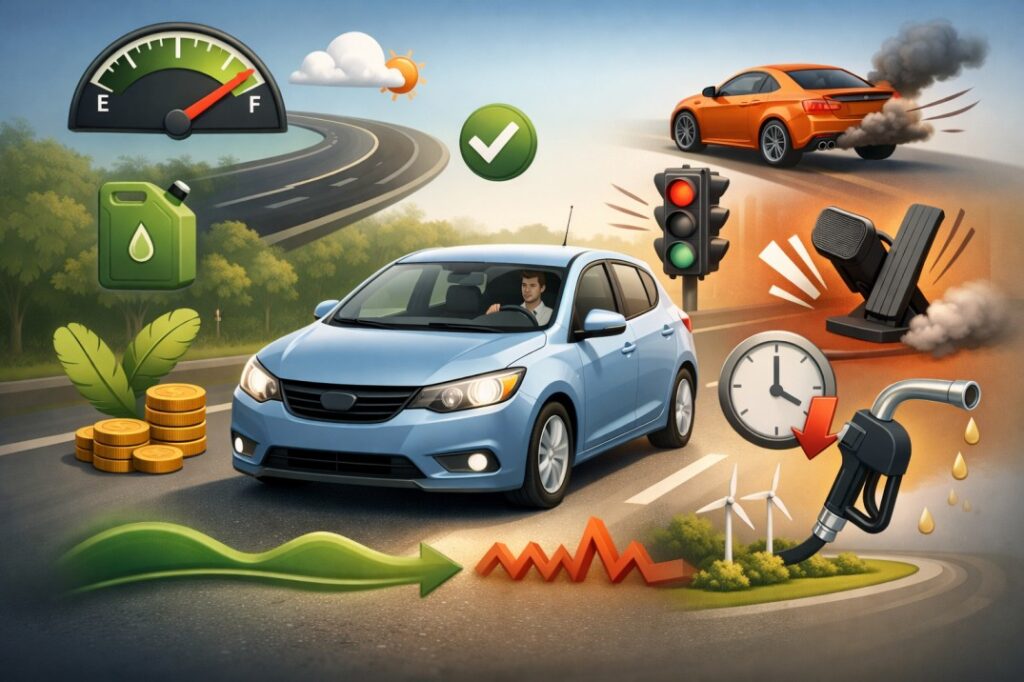
- Sudden acceleration → engine burns more fuel
- Hard braking → wastes energy already used
- Uneven driving → inefficient fuel usage
Smooth driving means:
- Gradual acceleration
- Consistent speed
- Controlled braking
If you understand how your car engine behaves, this becomes even clearer. You can read our guide on
car engine and powertrain explained in simple terms
https://carinsighthub.com/car-engine-and-powertrain-the-complete-guide/
Why Smooth Driving Actually Saves Fuel
1. Less Fuel Wasted During Acceleration
When you press the accelerator hard:
- Engine injects more fuel
- RPM increases quickly
Reality:
Most of that extra fuel doesn’t improve efficiency — it just gets wasted.
2. Reduced Braking = Less Energy Loss
Every time you brake:
- You lose momentum
- You waste fuel already used to gain speed
Smooth drivers:
- Anticipate traffic
- Brake less
3. Better Engine Efficiency
Engines perform best at:
- Steady speeds
- Moderate RPM
Smooth driving keeps the engine in this efficient range.
4. Less Gear Stress (Manual Cars)
In manual cars:
- Smooth gear shifts improve mileage
- Aggressive shifting reduces efficiency
5. Reduced AC Load Impact
Sudden acceleration:
- Increases engine load
- Makes AC work harder
Smooth driving keeps overall load balanced.
Key Benefits of Smooth Driving
- Improved mileage (10–25% better)
- Lower fuel expenses
- Reduced engine wear
- Longer brake life
- More comfortable driving experience
Step-by-Step Guide: How to Drive Smoothly
Step 1: Accelerate Gradually
- Press accelerator slowly
- Avoid sudden bursts
Step 2: Maintain Consistent Speed
- Avoid unnecessary speed changes
- Use steady throttle
Step 3: Anticipate Traffic
Look ahead:
- Signals
- Vehicles slowing down
This reduces sudden braking.
Step 4: Brake Smoothly
- Release accelerator early
- Use gradual braking
Step 5: Use Correct Gear (Manual Cars)
- Don’t drive in wrong gear
- Shift at proper RPM
Step 6: Avoid Unnecessary Idling
- Switch off engine at long signals
Comparison Table: Smooth Driving vs Aggressive Driving
| Feature | Smooth Driving | Aggressive Driving |
|---|---|---|
| Fuel consumption | Low | High |
| Engine stress | Low | High |
| Brake wear | Low | High |
| Driving comfort | High | Low |
| Maintenance cost | Lower | Higher |
Real-Life Example (India Case Study)
Case: Two Drivers, Same Car
Ravi and Kiran both drive the same petrol hatchback.
Ravi:
- Smooth acceleration
- Predictive braking
Mileage: ~17 km/l
Kiran:
- Sudden acceleration
- Frequent braking
Mileage: ~13–14 km/l
Difference:
Up to ₹2,000–₹3,000 monthly fuel savings just from driving style.
Common Mistakes That Waste Fuel
- Sudden acceleration
- Hard braking
- Driving at inconsistent speeds
- Idling for long periods
- Driving in wrong gear
You can also read our detailed guide on
driving habits that secretly damage your car in India
https://carinsighthub.com/driving-habits-that-secretly-damage-your-car-in-india-most-drivers-do-these-daily/
Expert Tips (From Real Indian Driving Patterns)
- Drive like you have a cup of tea in the car — no sudden moves
- Maintain safe distance to avoid braking
- Use cruise control on highways (if available)
- Keep tyre pressure correct
For better overall efficiency, read our guide on
how to save fuel in daily driving (top practical tips)
https://carinsighthub.com/how-to-save-fuel-in-daily-driving-top-10-tips/
Pros and Cons of Smooth Driving
| Pros | Cons |
|---|---|
| Saves fuel | Requires patience |
| Reduces wear and tear | Slower acceleration |
| Comfortable driving | Needs habit change |
| Lower maintenance cost | Not suitable for aggressive drivers |
Frequently Asked Questions (FAQs)
1. Does smooth driving really save fuel?
Yes, it can improve mileage by up to 20% in real conditions.
2. Is fast driving always bad for fuel?
Yes, aggressive acceleration increases fuel consumption.
3. What is the ideal speed for fuel efficiency?
Usually 60–80 km/h on highways.
4. Does braking affect fuel consumption?
Yes, frequent braking wastes fuel energy.
5. Is smooth driving good for the engine?
Yes, it reduces engine stress and wear.
6. Can automatic cars also benefit from smooth driving?
Yes, driving style affects all cars.
7. How long does it take to see results?
You can notice improvement within a few days.
Conclusion
Most people think saving fuel requires:
- Buying a new car
- Using premium fuel
- Installing accessories
But the truth is much simpler.
Your driving style has the biggest impact on fuel efficiency.
Smooth driving:
- Saves money
- Reduces stress
- Improves car life
In Indian conditions, where traffic is unpredictable and fuel prices are high, this simple habit can make a big difference.
You don’t need a new car to save fuel.
You just need to drive smarter.
References
- Government of India Automobile Portal: https://heavyindustries.gov.in
- NITI Aayog Mobility Reports: https://www.niti.gov.in
- SIAM Reports: https://www.siam.in
- Economic Times Auto: https://auto.economictimes.indiatimes.com
- Investopedia Automobile Industry Analysis: https://www.investopedia.com/articles/investing/090915/automobile-industry.asp
