Introduction
If you drive regularly in Indian cities like Chennai, Bangalore, or Delhi, your car faces a completely different kind of stress compared to highway driving.
Think about your daily routine:
- Stop-and-go traffic
- Long signals
- Slow crawling
- Frequent braking
Now imagine your engine dealing with this every single day.
Most car owners believe engine wear happens due to age or poor maintenance. But the truth is — city driving itself is one of the biggest reasons engines wear out faster in India.
And the surprising part? Many of these effects can be reduced with simple awareness.
In this article, we’ll break down exactly how city driving impacts your engine, what damage it causes over time, and what you can do to protect your car.
Understanding the Concept: Why City Driving Is Hard on Engines
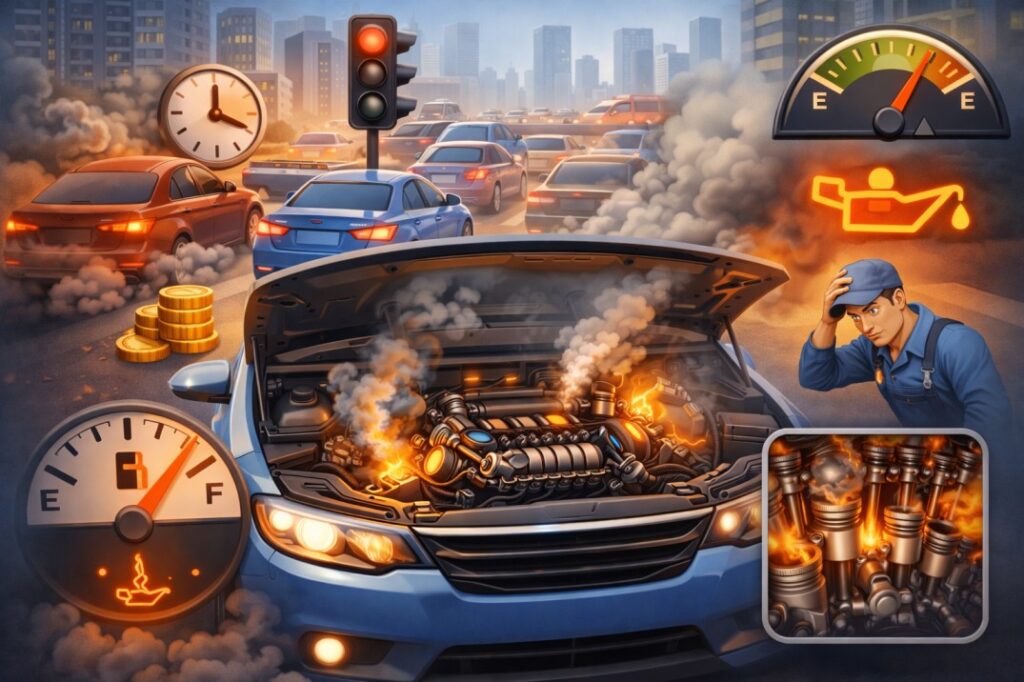
Your engine is designed to work efficiently when:
- It runs at steady speeds
- It maintains optimal temperature
- It operates within a balanced RPM range
But city driving does the opposite.
It involves:
- Constant acceleration and braking
- Idling for long periods
- Driving at low speeds
To understand this better, you can read our guide on
car engine and powertrain explained in simple terms
https://carinsighthub.com/car-engine-and-powertrain-the-complete-guide/
How City Driving Affects Your Engine
1. Frequent Stop-and-Go Increases Engine Wear
Every time you:
- Accelerate
- Slow down
- Stop
Your engine:
- Works harder
- Uses more fuel
Long-term impact:
- Increased wear on internal components
- Reduced engine efficiency
2. Idling at Signals Wastes Fuel and Damages Engine
In cities, cars spend a lot of time idling.
What happens during idling:
- Fuel burns without movement
- Engine runs inefficiently
Impact:
- Carbon deposits build up
- Reduced mileage
- Engine strain
3. Engine Doesn’t Reach Optimal Performance
Short city drives:
- Don’t allow engine to fully warm up
Impact:
- Poor combustion
- Increased deposits
- Reduced efficiency
4. Higher Heat Generation
City driving:
- Generates more heat due to frequent use
Impact:
- Stress on cooling system
- Faster wear of engine components
5. Increased Carbon Build-Up
Slow driving and idling:
- Lead to incomplete combustion
Impact:
- Carbon deposits inside engine
- Reduced performance
6. More Gear Changes (Manual Cars)
Constant gear shifting:
- Increases strain on engine and gearbox
7. Lower Fuel Efficiency
City driving:
- Consumes more fuel
To understand how to improve this, read our guide on
how to save fuel in daily driving (practical tips)
https://carinsighthub.com/how-to-save-fuel-in-daily-driving-top-10-tips/
Key Benefits of Understanding This
If you understand how city driving affects your engine, you can:
- Extend engine life
- Improve fuel efficiency
- Reduce maintenance costs
- Avoid major repairs
Step-by-Step Guide: How to Protect Your Engine in City Driving
Step 1: Avoid Unnecessary Idling
- Switch off engine at long signals
Step 2: Drive Smoothly
- Avoid sudden acceleration
- Brake gradually
Step 3: Take Occasional Highway Drives
- Helps clean engine deposits
- Improves performance
Step 4: Follow Proper Service Schedule
- Regular oil changes
- Filter replacement
Step 5: Use Correct Gear (Manual Cars)
- Avoid engine strain
Comparison Table: City Driving vs Highway Driving
| Factor | City Driving | Highway Driving |
|---|---|---|
| Engine load | High | Moderate |
| Fuel efficiency | Low | High |
| Wear and tear | High | Low |
| Driving pattern | Stop-go | Smooth |
| Engine performance | Less efficient | More efficient |
Real-Life Example (India Case Study)
Case: Two Drivers
Arun:
- Drives mostly in city
- Short daily trips
After 3 years:
- Reduced mileage
- Slight engine performance drop
Vijay:
- Mix of city + highway driving
After 3 years:
- Better performance
- Stable mileage
Lesson:
City-only driving accelerates engine wear.
Common Mistakes to Avoid
- Idling unnecessarily
- Driving aggressively in traffic
- Ignoring service schedule
- Not giving engine time to warm up
- Skipping long drives
You can also read our guide on
driving habits that secretly damage your car in India
https://carinsighthub.com/driving-habits-that-secretly-damage-your-car-in-india-most-drivers-do-these-daily/
Expert Tips (From Indian Driving Experience)
- Drive smoothly in traffic
- Turn off engine at long signals
- Take highway drive once a week or two
- Keep engine oil fresh
- Listen to unusual engine sounds
Also, understanding basic car care helps. Read our article on
things every car owner should understand but don’t
https://carinsighthub.com/things-every-car-owner-should-understand-but-dont-honest-indian-guide-that-saves-money/
Pros and Cons of City Driving
| Pros | Cons |
|---|---|
| Convenient for short trips | High engine wear |
| Easy access | Poor fuel efficiency |
| Practical for daily use | Increased maintenance |
| Suitable for urban life | Carbon build-up |
Frequently Asked Questions (FAQs)
1. Does city driving damage the engine?
Yes, it increases wear due to stop-go conditions.
2. Is idling bad for the engine?
Yes, it wastes fuel and causes deposits.
3. How can I protect my engine in city traffic?
Drive smoothly and follow maintenance schedule.
4. Are short trips harmful to cars?
Yes, they prevent engine from reaching optimal temperature.
5. Is highway driving better?
Yes, it improves engine efficiency.
6. How often should I take long drives?
Once every 1–2 weeks is helpful.
7. Does city driving reduce mileage?
Yes, significantly compared to highways.
Conclusion
City driving is unavoidable in India — but its impact on your engine is often underestimated.
The combination of:
- Traffic
- Idling
- Short trips
…slowly reduces engine performance over time.
But the good news is — you can control most of this.
By:
- Driving smoothly
- Avoiding unnecessary idling
- Maintaining your car properly
You can extend your engine life and reduce costs.
In Indian conditions, smart driving is not just about comfort — it’s about protecting your car for the long run.
References
- Government of India Automobile Portal: https://heavyindustries.gov.in
- NITI Aayog Mobility Reports: https://www.niti.gov.in
- SIAM Reports: https://www.siam.in
- Economic Times Auto: https://auto.economictimes.indiatimes.com
- Investopedia Automobile Industry Analysis: https://www.investopedia.com/articles/investing/090915/automobile-industry.asp
