Introduction
Buying a car is easy. Living with it for 5–10 years is the real challenge.
In India, many buyers focus on price, mileage, and features at the time of purchase. But after a few years, reality hits — rising maintenance costs, discomfort in daily driving, poor resale value, or simply a car that doesn’t fit your lifestyle anymore.
Long-term ownership is not about choosing the “best car” in the market. It’s about choosing the right car for your usage, budget, and future needs.
If you get this decision right, your car will feel like a smart investment. If you get it wrong, it becomes a constant expense.
In this article, I’ll break down how experienced buyers think, what factors actually matter over time, and how you can avoid common mistakes before signing that booking amount.
Understanding Long-Term Ownership (What It Really Means)
Long-term ownership in India typically means:
- 5 to 10 years of usage
- 60,000 to 1.5 lakh km driving
- Multiple service cycles
- Changing fuel prices and road conditions
During this period, your priorities will shift:
- Comfort becomes more important than features
- Maintenance cost becomes more important than mileage claims
- Reliability becomes more important than performance
If you understand how your car works internally, it becomes easier to make smarter decisions. You can refer to our guide on car engine and powertrain explained in simple terms (https://carinsighthub.com/car-engine-and-powertrain-the-complete-guide/) to build that basic understanding.
Key Factors That Actually Matter Long-Term
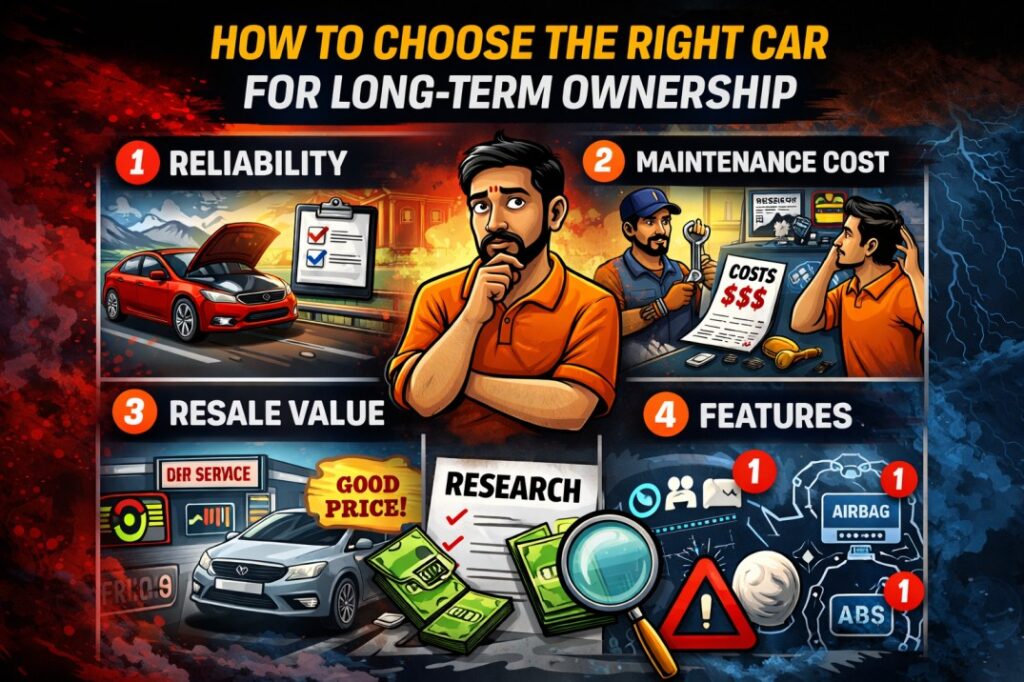
1. Reliability (Not Just Brand Name)
A reliable car means:
- Fewer breakdowns
- Consistent performance
- Lower unexpected costs
In India, reliability matters more because:
- Road conditions vary
- Service quality differs across cities
Don’t just go by brand reputation — check real owner feedback.
2. Maintenance Cost Reality
This is where many buyers regret later.
Maintenance includes:
- Regular servicing
- Spare parts cost
- Labour charges
A car that looks affordable initially can become expensive later.
To understand this better, read our detailed car maintenance cost guide in India (https://carinsighthub.com/car-maintenance-cost-guide-india-2025-model-wise/).
3. Fuel Efficiency in Real Conditions
Official mileage figures are often optimistic.
In real Indian usage:
- Traffic reduces mileage
- AC usage affects fuel efficiency
- Driving style matters
Over 5–7 years, even a small difference in mileage can cost lakhs.
4. Driving Comfort (Most Underrated Factor)
Comfort is not about luxury — it’s about daily usability.
Check:
- Seat support
- Driving position
- Suspension on bad roads
If your daily commute is long, comfort becomes more important than features.
5. Service Network and Availability
Even a good car becomes a problem if:
- Service centres are far
- Spare parts are delayed
Always check:
- Service centres in your city
- Availability of parts
6. Resale Value
You may not think about resale now, but after 5–7 years, it matters.
Cars with:
- Strong brand reputation
- Good reliability
- High demand
…usually retain better value.
Step-by-Step Guide to Choosing the Right Car
Step 1: Define Your Usage Clearly
Ask yourself:
- Daily city driving or highway use?
- Family use or personal commute?
- Short trips or long drives?
Step 2: Set a Practical Budget
Include:
- On-road price
- Insurance
- Maintenance cost
Don’t stretch your budget too much.
Step 3: Choose the Right Fuel Type
- Petrol → Low running, city use
- Diesel → High running, highways
- EV → Short daily commute
Step 4: Pick the Right Transmission
- Heavy traffic → Automatic
- Budget-friendly → Manual
You can explore this further in our guide on automatic vs manual in Indian traffic (https://carinsighthub.com/automatic-vs-manual-in-traffic-the-real-winner/).
Step 5: Take a Proper Test Drive
Don’t rush.
- Drive in traffic
- Test bad roads
- Check comfort
Step 6: Research Ownership Experience
Talk to:
- Existing owners
- Local mechanics
This gives real insights.
Comparison Table: Short-Term vs Long-Term Thinking
| Factor | Short-Term Buyer | Long-Term Buyer |
|---|---|---|
| Focus | Price & features | Reliability & cost |
| Test drive | Quick | Detailed |
| Decision | Emotional | Practical |
| Budget | Stretched | Balanced |
| Research | Online only | Real owner feedback |
Real-Life Example (India Case Study)
Amit from Delhi bought a feature-loaded compact SUV.
Why he chose it:
- Touchscreen
- Sunroof
- Design
After 3 years:
- High service cost
- Poor ride comfort on bad roads
- Average mileage
His regret:
“I focused on features instead of long-term practicality.”
Common Mistakes to Avoid
- Buying based on features only
- Ignoring maintenance cost
- Not considering daily usage
- Overstretching budget
- Skipping proper test drive
You can also read our article on things every car owner should understand but don’t for deeper insights:
Expert Tips (From Real Indian Ownership Patterns)
- Always think 5 years ahead, not just today
- Comfort and reliability matter more than features
- Choose cars with proven track record
- Avoid over-complicated technology
- Keep ownership cost in mind
If you’re planning your purchase, go through our car buying guide that actually saves money in India (https://carinsighthub.com/read-this-before-buying-your-next-car-in-india-a-practical-guide-that-actually-saves-you-money/).
Pros and Cons of Long-Term Focus
| Pros | Cons |
|---|---|
| Lower overall cost | Less focus on flashy features |
| Better ownership experience | Requires more research |
| Higher resale value | Slower decision-making |
| Fewer surprises | Needs planning |
Frequently Asked Questions (FAQs)
1. What is the most important factor for long-term ownership?
Reliability and maintenance cost are the most important factors.
2. Should I prioritise mileage or comfort?
Both matter, but comfort becomes more important in daily usage.
3. Is it better to buy petrol or diesel for long-term use?
Depends on your running. High usage → diesel, low usage → petrol.
4. How important is resale value?
Very important, especially after 5–7 years.
5. Is automatic good for long-term ownership?
Yes, if maintained properly, but repair costs can be higher.
6. Should I buy a feature-loaded car?
Only if it fits your usage. Don’t compromise practicality.
7. How long should I plan to keep a car?
Ideally 5–10 years for best value.
Conclusion
Choosing the right car for long-term ownership is not about finding the most popular model — it’s about making a decision that will still make sense after 5 years.
Most regrets come from:
- Ignoring real usage
- Focusing on short-term excitement
- Underestimating maintenance costs
If you focus on:
- Reliability
- Comfort
- Ownership cost
You won’t just buy a car — you’ll make a smart long-term investment.
In India, where conditions are unpredictable and costs are rising, thinking long-term is the smartest way to buy a car.
References
- Government of India Automobile Portal: https://heavyindustries.gov.in
- NITI Aayog Mobility Reports: https://www.niti.gov.in
- SIAM Reports: https://www.siam.in
- Economic Times Auto: https://auto.economictimes.indiatimes.com
- Investopedia Automobile Industry Analysis:
