Introduction
If you’re buying a car in India today, chances are you’re stuck between two popular options:
Hatchback or Compact SUV?
On paper, the answer seems simple:
- Hatchback → affordable and practical
- Compact SUV → stylish and more “premium”
But real ownership tells a different story.
Many buyers choose compact SUVs for looks and road presence — only to realise later that:
- Fuel costs are higher
- Parking becomes difficult
- Some features are not even useful daily
At the same time, hatchback buyers sometimes feel:
- They compromised on space or status
So what actually makes sense in Indian conditions?
In this article, we’ll break it down honestly — based on real usage, not trends or showroom talk.
Understanding the Core Difference
Let’s keep it simple.
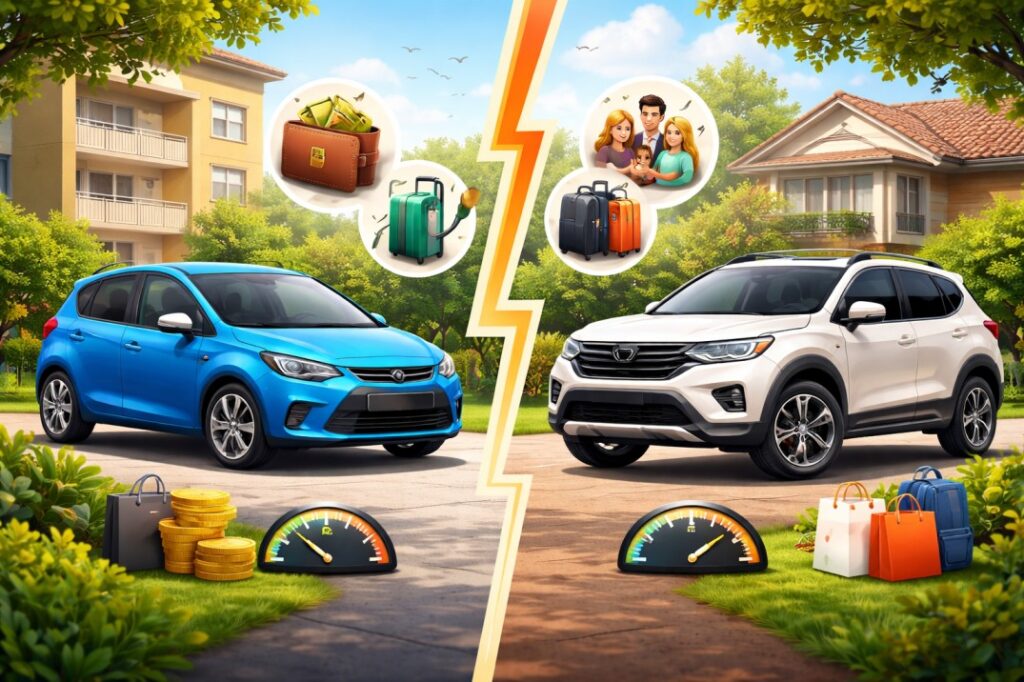
- Hatchback → small, lightweight, city-focused car
- Compact SUV → slightly bigger, higher ground clearance, more features
But the real difference shows up in:
- Daily driving
- Comfort
- Cost of ownership
If you want to understand how these cars differ mechanically, you can explore
car engine and powertrain explained in simple terms
https://carinsighthub.com/car-engine-and-powertrain-the-complete-guide/
Why Hatchbacks Still Make Sense
Hatchbacks are often underrated today, but they are still one of the smartest choices for Indian cities.
Key advantages:
- Easy to drive in traffic
- Simple to park in tight spaces
- Better fuel efficiency
- Lower purchase cost
- Lower maintenance cost
For daily city users, hatchbacks are extremely practical.
Why Compact SUVs Are So Popular
Compact SUVs are dominating the market — and for good reasons.
What attracts buyers:
- Higher seating position
- Better ground clearance
- Strong road presence
- More features
They feel more “premium” compared to hatchbacks.
The Reality Most Buyers Don’t Consider
1. City Driving Experience
Hatchback:
- Easy manoeuvring
- Less stress in traffic
Compact SUV:
- Better visibility
- Slightly bulkier
Reality:
For tight Indian streets, hatchbacks are still easier.
2. Parking Situation
Hatchback:
- Fits easily in small spaces
Compact SUV:
- Needs more space
- Can be difficult in apartments
3. Fuel Cost Over Time
Compact SUVs:
- Heavier
- Lower mileage
Hatchbacks:
- Better fuel efficiency
Over 5 years, this difference becomes significant.
4. Ride Quality on Bad Roads
Compact SUV:
- Handles potholes and speed breakers better
Hatchback:
- Struggles on rough roads
If your area has bad roads, this matters a lot.
5. Comfort and Space
Compact SUV:
- More space
- Better seating position
Hatchback:
- Limited space
- Best for small families
Step-by-Step: How to Choose What Fits You
Step 1: Check Your Daily Usage
- Pure city driving → Hatchback
- Mixed roads → Compact SUV
Step 2: Look at Your Parking Situation
- Tight parking → Hatchback
- Spacious parking → SUV
Step 3: Consider Budget
- Budget-focused → Hatchback
- Flexible budget → Compact SUV
Step 4: Think About Road Conditions
- Good roads → Hatchback
- Bad roads → Compact SUV
Step 5: Don’t Ignore Long-Term Cost
- Hatchback → cheaper to maintain
- SUV → higher running cost
Comparison Table: Hatchback vs Compact SUV
| Feature | Hatchback | Compact SUV |
|---|---|---|
| Price | Lower | Higher |
| Fuel efficiency | Better | Lower |
| Parking ease | Easy | Difficult |
| Ground clearance | Low | High |
| Comfort | Moderate | Better |
| Maintenance | Low | Higher |
| Road presence | Basic | Strong |
Real-Life Example (Indian Case Study)
Case 1: Hatchback Owner
Priya from Chennai:
- Daily office commute
- Tight apartment parking
After 3 years:
- Easy driving
- Low fuel cost
- No parking issues
Case 2: Compact SUV Owner
Arvind from Bangalore:
- Mixed city + weekend travel
After 2 years:
- Comfortable on bad roads
- Better visibility
- Slightly higher running cost
Reality:
Both are satisfied — because they chose based on usage.
Common Mistakes to Avoid
- Buying SUV just for status
- Ignoring parking challenges
- Not considering fuel cost
- Choosing hatchback for bad roads
- Skipping real-world test drive
You can also read our article on
things every car owner should understand but don’t
https://carinsighthub.com/things-every-car-owner-should-understand-but-dont-honest-indian-guide-that-saves-money/
Expert Tips (From Indian Ownership Trends)
- Hatchbacks are still best for city life
- Compact SUVs are better for mixed usage
- Don’t buy SUV just for trend
- Always match car with your lifestyle
If you’re planning your purchase, read our
car buying guide that actually saves money in India
https://carinsighthub.com/read-this-before-buying-your-next-car-in-india-a-practical-guide-that-actually-saves-you-money/
Pros and Cons Table
| Pros of Hatchback | Cons of Hatchback |
|---|---|
| Affordable | Limited space |
| Easy to drive | Low ground clearance |
| Fuel efficient | Less premium feel |
| Pros of Compact SUV | Cons of Compact SUV |
|---|---|
| Better ground clearance | Higher cost |
| More space | Lower mileage |
| Strong road presence | Parking difficulty |
Frequently Asked Questions (FAQs)
1. Which is better for city driving?
Hatchbacks are better for city use due to ease of driving and parking.
2. Is compact SUV worth the extra cost?
Yes, if you need better ground clearance and space.
3. Do SUVs consume more fuel?
Yes, generally more than hatchbacks.
4. Which is better for beginners?
Hatchbacks are easier for beginners.
5. Is hatchback outdated?
No, it is still very practical for Indian cities.
6. Which is better for bad roads?
Compact SUV is better due to higher ground clearance.
7. What should I choose?
Choose based on your daily usage and road conditions.
Conclusion
Hatchback vs compact SUV is not about which is better — it’s about which fits your life.
Choose hatchback if:
- You drive mostly in city
- You want low cost and easy handling
Choose compact SUV if:
- You face bad roads
- You want more space and comfort
In India, both options make sense — but only when chosen wisely.
The smartest buyers don’t follow trends — they follow their needs.
References
- Government of India Automobile Portal: https://heavyindustries.gov.in
- NITI Aayog Mobility Reports: https://www.niti.gov.in
- SIAM Reports: https://www.siam.in
- Economic Times Auto: https://auto.economictimes.indiatimes.com
- Investopedia Automobile Industry Analysis:
