Introduction
When buying a car in India, one of the biggest decisions is this:
Should you go for a budget car or stretch for a premium one?
At first glance, the difference seems obvious:
- Budget car → saves money
- Premium car → better features
But the real story is much deeper.
Because your money doesn’t just go into:
- Engine
- Size
- Brand
It goes into:
- Comfort
- Technology
- Safety
- Long-term ownership experience
Many buyers stretch their budget thinking premium is “worth it” — and later feel the pressure. Others go for budget cars and regret missing out on comfort.
So where does your money actually go?
Let’s break it down in a practical, Indian context.
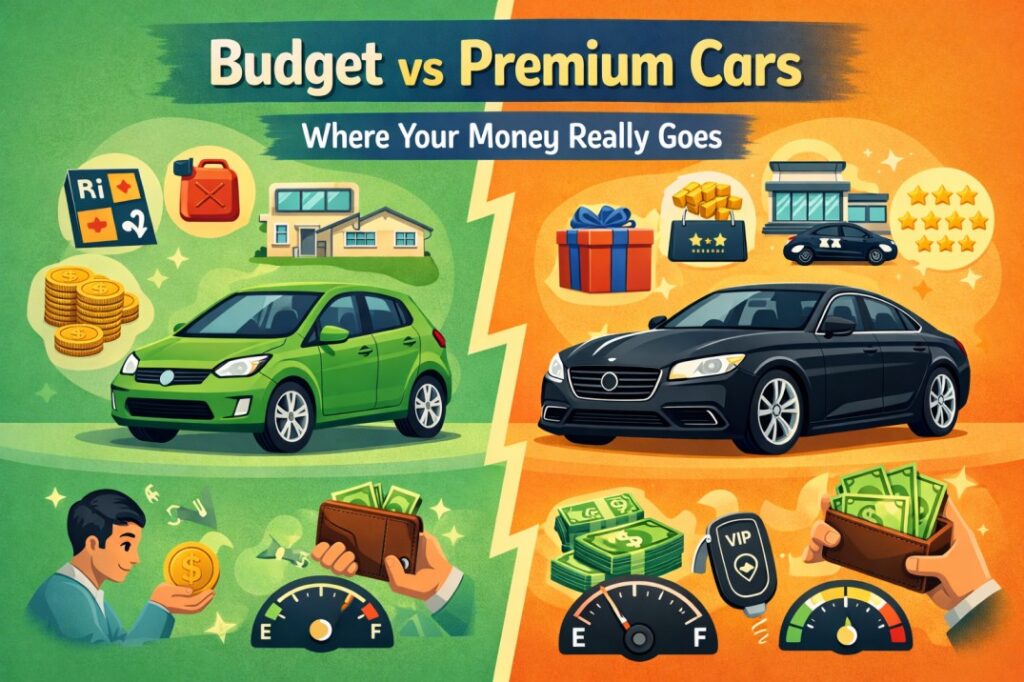
Understanding Budget vs Premium Cars
Budget Cars (₹5–10 lakh range)
Typical examples:
- Hatchbacks
- Entry-level compact sedans
What they focus on:
- Affordability
- Fuel efficiency
- Basic features
Premium Cars (₹10–25 lakh+ range)
Typical examples:
- Compact SUVs
- Sedans
- Mid-size SUVs
What they focus on:
- Comfort
- Features
- Performance
- Brand value
If you want to understand how these cars differ mechanically, you can read our guide on
car engine and powertrain explained in simple terms
https://carinsighthub.com/car-engine-and-powertrain-the-complete-guide/
Where Your Money Actually Goes
1. Build Quality and Materials
Budget cars:
- Lightweight materials
- Basic interiors
Premium cars:
- Better build quality
- Soft-touch materials
- Improved durability
Reality:
You feel this difference daily — especially after 2–3 years.
2. Driving Comfort and Ride Quality
Budget cars:
- Basic suspension
- Average seat comfort
Premium cars:
- Better suspension tuning
- More comfortable seats
- Less fatigue on long drives
This is one of the biggest real-world differences.
3. Features and Technology
Budget cars:
- Basic infotainment
- Essential features
Premium cars:
- Bigger screens
- Connected tech
- ADAS (in some cases)
But here’s the truth:
Many features look good but are rarely used daily.
4. Safety
Budget cars:
- Basic safety features
Premium cars:
- Better structural strength
- More airbags
- Advanced safety tech
Safety is one area where spending more often makes sense.
5. Engine Performance
Budget cars:
- Smaller engines
- Built for efficiency
Premium cars:
- More powerful engines
- Better highway performance
6. Brand Value and Perception
Premium cars:
- Stronger brand image
- Better resale perception
Budget cars:
- Practical, but less aspirational
The Hidden Cost Difference
Budget Cars:
- Lower purchase price
- Lower insurance
- Lower maintenance
Premium Cars:
- Higher purchase cost
- Higher service cost
- Expensive spare parts
To understand maintenance better, read our guide on
car maintenance cost in India model-wise
https://carinsighthub.com/car-maintenance-cost-guide-india-2025-model-wise/
Step-by-Step: How to Decide What’s Worth It
Step 1: Define Your Usage
- Daily city commute → Budget car is enough
- Frequent long drives → Premium car makes sense
Step 2: Evaluate Comfort Needs
- Short drives → Budget works
- Long daily drives → Premium is better
Step 3: Check Financial Comfort
Ask:
- Will higher EMI stress you?
If yes → stay within budget.
Step 4: Think Long-Term
- 5–7 years ownership → comfort matters more
- Short-term use → budget is fine
Step 5: Avoid Feature Trap
Don’t pay extra for:
- Features you won’t use
Comparison Table: Budget vs Premium Cars
| Feature | Budget Cars | Premium Cars |
|---|---|---|
| Price | Low | High |
| Comfort | Basic | Excellent |
| Features | Limited | Advanced |
| Maintenance | Low | High |
| Performance | Moderate | Strong |
| Safety | Basic | Better |
| Ownership experience | Practical | Refined |
Real-Life Example (Indian Case Study)
Case 1: Budget Car Owner
Ramesh from Chennai bought a hatchback.
After 4 years:
- Low maintenance cost
- Good mileage
- But average comfort
Case 2: Premium Car Owner
Anil from Bangalore bought a compact SUV.
After 3 years:
- Comfortable long drives
- Better features
- Higher service cost
Reality:
Budget saved money. Premium improved experience.
Common Mistakes Buyers Make
- Stretching budget just for brand
- Ignoring long-term maintenance cost
- Paying for unused features
- Underestimating comfort importance
You can also read our article on
things every car owner should understand but don’t
https://carinsighthub.com/things-every-car-owner-should-understand-but-dont-honest-indian-guide-that-saves-money/
Expert Tips (From Real Ownership Trends)
- Don’t buy premium just for status
- Don’t buy budget if you drive long distances daily
- Comfort matters more than features
- Always calculate total ownership cost
If you’re planning your purchase, read our
car buying guide that actually saves money in India
https://carinsighthub.com/read-this-before-buying-your-next-car-in-india-a-practical-guide-that-actually-saves-you-money/
Pros and Cons Table
| Pros of Budget Cars | Cons of Budget Cars |
|---|---|
| Affordable | Basic comfort |
| Low maintenance | Limited features |
| Fuel efficient | Less premium feel |
| Pros of Premium Cars | Cons of Premium Cars |
|---|---|
| High comfort | Expensive |
| Better features | Higher maintenance |
| Strong performance | Higher running cost |
Frequently Asked Questions (FAQs)
1. Are premium cars worth the money?
Yes, if you value comfort, safety, and long-term driving experience.
2. Do budget cars last long?
Yes, with proper maintenance they can last many years.
3. Is maintenance high for premium cars?
Yes, compared to budget cars.
4. Should I stretch my budget for a better car?
Only if it doesn’t create financial stress.
5. Which is better for daily use?
Budget cars are practical for city use.
6. Do premium cars have better resale?
Generally yes, but depends on brand.
7. What is the biggest mistake buyers make?
Choosing based on status instead of usage.
Conclusion
Budget vs premium is not about right or wrong — it’s about what fits your life.
Budget cars:
- Save money
- Offer practicality
Premium cars:
- Offer comfort
- Improve daily experience
The key is balance.
If you understand where your money is actually going, you won’t regret your decision later.
In India, smart car buying is not about spending more — it’s about spending wisely.
References
- Government of India Automobile Portal: https://heavyindustries.gov.in
- NITI Aayog Mobility Reports: https://www.niti.gov.in
- SIAM Reports: https://www.siam.in
- Economic Times Auto: https://auto.economictimes.indiatimes.com
- Investopedia Automobile Industry Analysis: https://www.investopedia.com/articles/investing/090915/automobile-industry.asp
