Introduction
If you’ve ever driven during peak hours in cities like Mumbai, Bangalore, or Delhi, you already know one thing — traffic in India is not just slow, it’s exhausting.
You’re constantly:
- Pressing the clutch
- Shifting between 1st and 2nd gear
- Braking every few seconds
Now imagine doing this every single day for office commute.
That’s exactly why the “automatic vs manual” debate has become serious in India. Earlier, manual cars were the default choice. But today, more buyers are asking — is automatic actually worth it in Indian traffic?
In this article, I’m not going to give you a textbook comparison. Instead, I’ll break down what really happens on Indian roads, what most owners experience after 1–2 years, and which option actually makes sense for your daily life.
Understanding the Real Difference (Beyond Theory)
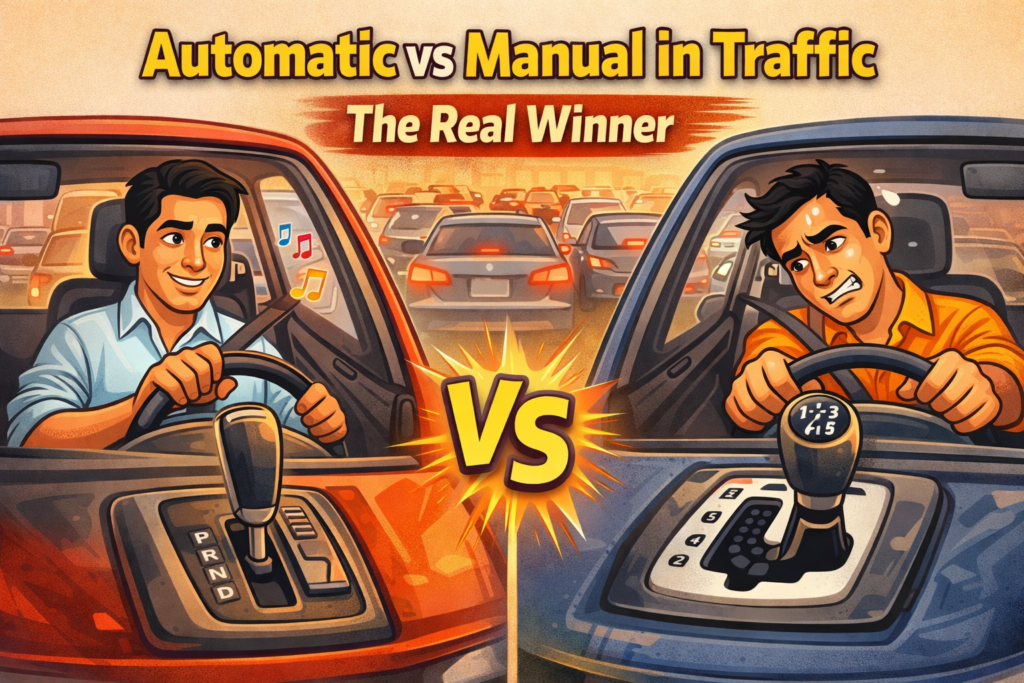
On paper, the difference is simple:
- Manual = You control gears
- Automatic = Car controls gears
But in India, the difference is not technical — it’s physical and mental.
In heavy traffic:
- Manual becomes a leg workout
- Automatic becomes a stress reliever
And this is not an exaggeration.
If you want to understand how your car’s powertrain actually works, you can read our detailed guide on car engine and powertrain explained in simple terms (https://carinsighthub.com/car-engine-and-powertrain-the-complete-guide/).
What Driving a Manual in Traffic Actually Feels Like
Let’s be honest.
If your daily route includes:
- Signals every 200–300 meters
- Slow-moving traffic
- Frequent stop-go situations
Then manual driving becomes tiring very quickly.
Real problems manual owners face:
- Left leg pain (especially in clutch-heavy cars)
- Constant gear shifting
- Mental fatigue after long drives
- Frustration in bumper-to-bumper traffic
Many owners don’t realise this during test drive because:
- Test drives rarely happen in peak traffic
- You drive for only 10–15 minutes
Reality hits after purchase.
What Driving an Automatic Feels Like in Indian Traffic
Now switch to an automatic.
Suddenly:
- No clutch
- No constant gear changes
- Just brake and accelerate
That’s it.
In cities like Bangalore or Pune, where traffic barely moves during peak hours, this makes a massive difference.
What owners usually say after switching:
- “I don’t feel tired anymore”
- “Driving feels easy now”
- “Traffic is still bad, but at least I’m not stressed”
That’s the real benefit — not speed, not performance — but reduced fatigue.
But Here’s the Truth Most People Don’t Tell You
Automatic cars are not perfect.
And this is where many first-time buyers get surprised.
1. Mileage Drop is Real
Expect:
- 1–2 km/l lower than manual
- Even more in city traffic
With petrol at ₹100+, this adds up over time.
2. Wrong Gearbox Choice Can Ruin Experience
Not all automatics behave the same.
- AMT → Jerky in traffic
- CVT → Smooth but slightly noisy
- DCT → Fast but heats up in traffic
If you choose wrong, you’ll regret it.
We’ve covered this in detail in our guide on automatic cars that people drive wrong in India (https://carinsighthub.com/automatic-cars-are-easier-but-most-owners-drive-them-wrong-indian-reality-exposed/).
3. Repair Costs Can Shock You
Manual gearbox issue → ₹5,000–₹15,000
Automatic gearbox issue → ₹50,000+
This is the biggest long-term risk.
Step-by-Step: How to Decide What’s Right for You
Let’s simplify this decision based on real usage.
Step 1: Look at Your Daily Drive
- 70–80% city traffic → Go automatic
- Mostly highways → Manual is fine
Step 2: Be Honest About Your Patience
Ask yourself:
- Do you enjoy driving in traffic?
- Or do you just tolerate it?
If it feels like a daily struggle → automatic is worth it.
Step 3: Check Your Budget Beyond Buying Price
Don’t just look at:
- Car price
Also consider:
- Fuel cost
- Service cost
- Long-term maintenance
Step 4: Test Drive in Real Conditions
This is critical.
- Drive during peak hours
- Take bad roads
- Sit in traffic for 10–15 minutes
Only then you’ll understand the difference.
Comparison Table: Real Indian Usage
| Feature | Automatic | Manual |
|---|---|---|
| Comfort in traffic | Excellent | Poor |
| Driver fatigue | Very low | High |
| Mileage | Lower | Better |
| Maintenance cost | High | Low |
| Ease of use | Very easy | Requires effort |
| Long traffic drives | Relaxed | Stressful |
Real-Life Case: Mumbai Office Commute
Rahul, working in Andheri, used to drive a manual hatchback.
Daily routine:
- 1 hour morning traffic
- 1.5 hours evening traffic
After 2 years:
- Constant leg pain
- Started avoiding driving
He switched to an automatic compact SUV.
After 6 months:
- No fatigue
- Started enjoying driving again
His only complaint:
- Slightly higher fuel cost
But for him, comfort was worth it.
Mistakes Most Indian Buyers Make
- Choosing manual just to save ₹50,000–₹1 lakh
- Not understanding gearbox types
- Ignoring daily usage reality
- Believing “I’ll get used to it”
Also, many people follow bad habits that damage cars. You can read our guide on driving habits that secretly damage your car in India (https://carinsighthub.com/driving-habits-that-secretly-damage-your-car-in-india-most-drivers-do-these-daily/).
Expert Advice (From Real Ownership Experience)
- If you drive daily in city → automatic is not luxury, it’s practicality
- Don’t buy DCT for heavy traffic routes
- CVT and torque converters are best for city comfort
- Always check service cost before buying
If you’re still confused, go through our detailed car buying guide that actually saves money in India (https://carinsighthub.com/read-this-before-buying-your-next-car-in-india-a-practical-guide-that-actually-saves-you-money/).
Pros and Cons Table
| Pros of Automatic | Cons of Automatic |
|---|---|
| Stress-free driving | Expensive repairs |
| Ideal for traffic | Lower mileage |
| Easy to learn | Higher cost |
| Pros of Manual | Cons of Manual |
|---|---|
| Better mileage | Very tiring in traffic |
| Lower maintenance | Requires effort |
| Cheaper to buy | Not ideal for daily commute |
Frequently Asked Questions (FAQs)
1. Is automatic really better for Indian traffic?
Yes. In daily stop-go traffic, automatic cars reduce fatigue significantly.
2. Why do some people still prefer manual cars?
Because they are cheaper, give better mileage, and have lower maintenance cost.
3. Is automatic worth the extra money?
If you drive daily in traffic, it is absolutely worth it.
4. Which automatic type is best for city use?
CVT and torque converter are the most comfortable options.
5. Do automatic cars have more problems?
Not necessarily, but repairs are more expensive if something goes wrong.
6. Can beginners start with automatic cars?
Yes, they are actually easier and more confidence-building.
7. Will manual cars disappear in India?
Not anytime soon. Budget buyers still prefer them.
Conclusion
So, who is the real winner?
If your life involves daily city traffic, long commutes, and constant stop-go driving — automatic cars win clearly.
Not because they are advanced, but because they make your daily life easier.
Manual cars still make sense if:
- Your driving is limited
- Your budget is tight
- You enjoy full control
But for most urban Indian drivers today, the decision is becoming very clear.
Comfort is no longer a luxury — it’s becoming a necessity.
And in Indian traffic, automatic cars deliver exactly that.
References
- Government of India Automobile Portal: https://heavyindustries.gov.in
- NITI Aayog Mobility Reports: https://www.niti.gov.in
- SIAM Reports: https://www.siam.in
- Economic Times Auto: https://auto.economictimes.indiatimes.com
- Investopedia Automobile Industry Analysis: https://www.investopedia.com/articles/investing/090915/automobile-industry.asp
