Introduction
Electric cars are no longer a future concept in India — they are already on our roads. From Tata Nexon EVs in cities to MG ZS EVs on highways, EV adoption is growing steadily.
At the same time, petrol cars continue to dominate because of:
- Lower upfront cost
- Easy refuelling
- Proven reliability
So the big question for today’s Indian buyer is simple:
Should you go electric or stick with petrol for daily use?
The answer is not one-size-fits-all. It depends on your daily driving pattern, budget, charging access, and long-term expectations.
In this article, we’ll break down real-world usage, costs, and practicality — not just brochure claims — so you can make a smart decision.
Understanding the Core Difference
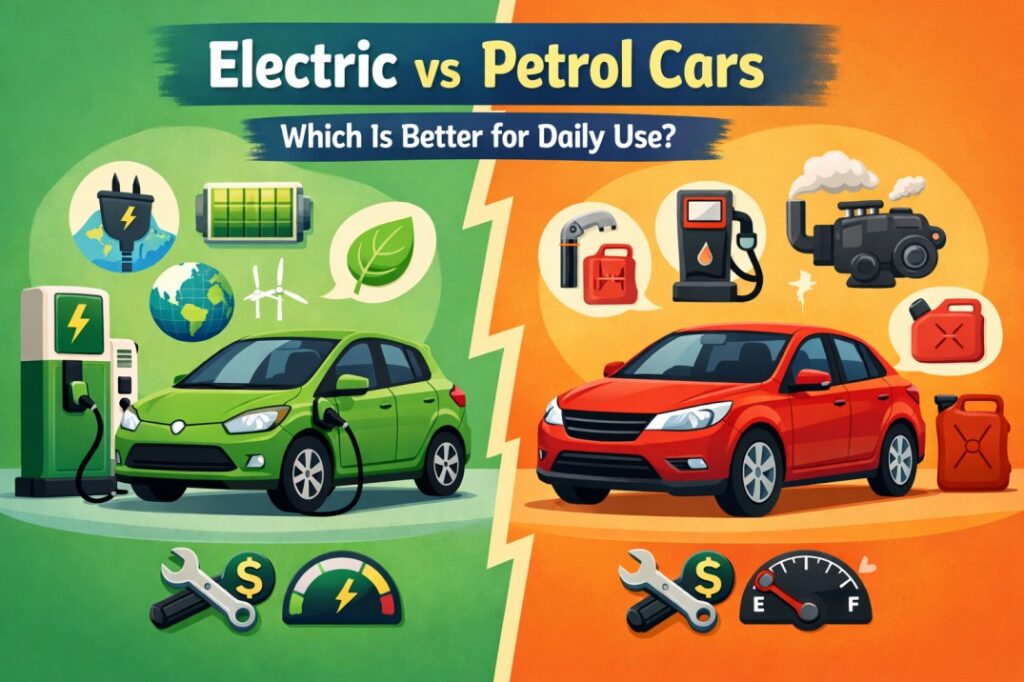
Let’s simplify the basics.
- Petrol Car → Runs on fuel, internal combustion engine
- Electric Car (EV) → Runs on battery, electric motor
This difference affects:
- Running cost
- Maintenance
- Driving experience
If you want to understand how traditional engines work, you can read our guide on car engine and powertrain explained in simple terms to build a solid foundation.
Key Benefits of Electric Cars (EVs)
- Very low running cost (₹1–₹2 per km approx)
- Silent and smooth driving
- No fuel dependency
- Lower maintenance (fewer moving parts)
- Government incentives and subsidies
If you’re curious about actual charging expenses, check our detailed guide on how much it costs to charge an EV at home in India.
Key Benefits of Petrol Cars
- Lower upfront cost
- Easy refuelling anywhere
- No range anxiety
- Wider service network
- Better for long-distance travel
Petrol cars are still the safest choice for many first-time buyers.
Real Daily Usage: What Actually Matters
1. Running Cost (Biggest Advantage for EVs)
- Petrol → ₹7–₹10 per km
- EV → ₹1–₹2 per km
Reality:
If you drive daily, EV can save thousands per month.
2. Charging vs Refuelling Convenience
- Petrol → 5 minutes at any fuel station
- EV → 6–8 hours home charging / limited public chargers
Reality:
- EV is convenient only if you have home charging
- Otherwise, it becomes stressful
3. Range and Practicality
- Petrol → 500–700 km easily
- EV → 200–400 km (real-world)
Reality:
- Petrol wins for long trips
- EV is ideal for city commuting
4. Maintenance Cost
- Petrol → Regular servicing required
- EV → Lower maintenance
To understand general servicing basics, you can read our guide on car maintenance tips for fluids and filters.
5. Driving Experience
- Petrol → Familiar, responsive
- EV → Instant acceleration, very smooth
Many first-time EV drivers are surprised by how smooth it feels.
Step-by-Step: Which One Should You Choose?
Step 1: Check Your Daily Running
- Less than 30–40 km/day → EV makes sense
- More than 50–60 km/day → depends on charging access
Step 2: Do You Have Home Charging?
- Yes → EV is practical
- No → Petrol is safer
Step 3: Consider Your Budget
- EV → Higher upfront cost
- Petrol → Lower initial cost
Step 4: Think About Usage Type
- City driving → EV
- Frequent highway trips → Petrol
Step 5: Look at Long-Term Cost
EV:
- High purchase cost
- Low running cost
Petrol:
- Lower purchase cost
- Higher running cost
Comparison Table: EV vs Petrol (India Daily Use)
| Feature | Electric Car | Petrol Car |
|---|---|---|
| Running cost | Very low | High |
| Purchase cost | High | Lower |
| Maintenance | Low | Moderate |
| Range | Limited | High |
| Refuelling/Charging | Slow | Fast |
| City driving | Excellent | Good |
| Highway use | Limited | Excellent |
Real-Life Example (Indian Case Study)
Case 1: EV Owner (City Use)
Meena from Chennai:
- Daily commute: 25 km
- Charges car at home
After 1 year:
- Huge savings on fuel
- Very smooth driving
- No major maintenance
Case 2: Petrol Owner (Mixed Use)
Rahul from Pune:
- Daily use + frequent highway trips
After 2 years:
- No range issues
- Easy refuelling
- Higher fuel expenses
Conclusion:
Both are happy — because they chose based on usage.
Common Mistakes to Avoid
- Buying EV without home charging
- Ignoring real driving range
- Choosing petrol without considering fuel cost
- Not thinking long-term
You can also read our guide on things every car owner should understand but don’t to avoid common ownership mistakes:
Expert Tips (From Indian Ownership Trends)
- EV is best for predictable daily usage
- Petrol is better for flexibility and long trips
- Always calculate 5-year cost
- Don’t buy EV just for trend
If you’re planning your purchase, go through our car buying guide that actually saves money in India for a smarter decision.
Pros and Cons Table
| Pros of EV | Cons of EV |
|---|---|
| Low running cost | High upfront cost |
| Smooth driving | Charging time |
| Low maintenance | Range limitations |
| Pros of Petrol | Cons of Petrol |
|---|---|
| Easy refuelling | High fuel cost |
| Lower price | More maintenance |
| Better range | Less efficient |
Frequently Asked Questions (FAQs)
1. Is EV cheaper than petrol car in India?
Running cost is cheaper, but purchase cost is higher.
2. Is EV good for daily use?
Yes, especially for city commuting with home charging.
3. What is the biggest problem with EVs?
Charging infrastructure and range anxiety.
4. Are petrol cars still better?
Yes, for long-distance travel and flexibility.
5. How much can I save with EV?
Depends on usage, but significant savings over time.
6. Is EV maintenance really low?
Yes, due to fewer moving parts.
7. Should I switch to EV now?
Only if your usage and charging setup support it.
Conclusion
Electric vs petrol is not about which is better — it’s about which is better for your life.
Choose EV if:
- Your daily usage is predictable
- You have home charging
- You want low running cost
Choose petrol if:
- You travel long distances
- You want flexibility
- You prefer lower upfront cost
In India today, both options make sense — but only when chosen correctly.
The smart buyer is not the one who follows trends — but the one who understands their needs.
References
- Government of India EV Portal: https://heavyindustries.gov.in
- NITI Aayog EV Reports: https://www.niti.gov.in
- SIAM Reports: https://www.siam.in
- Economic Times Auto: https://auto.economictimes.indiatimes.com
- Investopedia Automobile Industry Analysis: https://www.investopedia.com/articles/investing/090915/automobile-industry.asp
