Think you drive safely? These everyday driving habits slowly damage your car and drain your money. Real Indian stories, myths vs reality, mistakes to avoid, FAQs, and practical fixes.
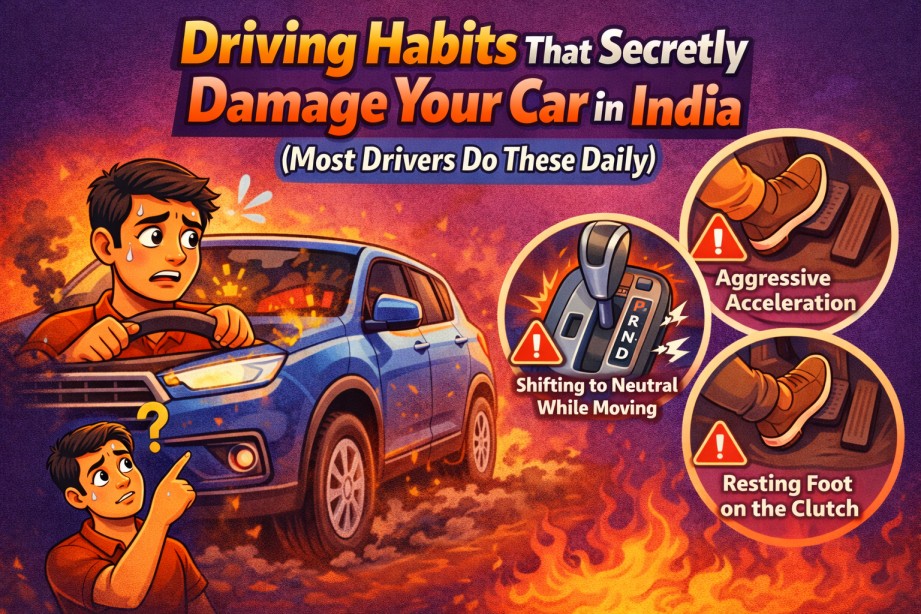
Driving Habits That Secretly Damage Your Car
(And Cost You Thousands Without You Realising)
Most Indian car owners believe one thing very confidently:
“I drive carefully. My car problems are just bad luck.”
Hard truth?
It’s rarely bad luck.
In India, cars don’t die suddenly — they are slowly tortured every single day by small driving habits we ignore because they feel normal.
This article is not meant to scare you.
It’s meant to save you repair bills, breakdown stress, and resale value loss.
If you drive daily, read this carefully.
Why Driving Habits Matter More Than Brand or Price
You can buy:
- The most reliable car
- The best engine
- The safest brand
And still ruin it faster than expected.
Why?
Because how you drive matters more than what you drive.
Indian conditions amplify damage:
- Traffic jams
- Bad fuel quality
- Short trips
- Speed breakers
- Heat, dust, monsoons
Real-Life Story #1: “The Clutch Failed at 32,000 km”
Rohit, a sales executive from Indore, proudly said:
“Bhai, clutch toh gaadi ka wear item hota hai.”
At just 32,000 km, his clutch failed.
Service centre diagnosis?
- Riding the clutch in traffic
- Holding car on half clutch at signals
- Frequent gear changes without full clutch press
Repair bill: ₹18,000
His reaction:
“Mujhe laga main smooth driving karta hoon.”
Habit #1: Riding the Clutch in Traffic
This is one of the most common car-killing habits in India.
What People Do:
- Keep foot resting on clutch
- Half clutch in slow traffic
- Holding car on slope using clutch
What It Actually Does:
- Overheats clutch plate
- Reduces clutch life by 50%
- Leads to premature replacement
Better Habit:
- Use neutral at signals
- Fully release clutch after gear change
- Use handbrake on slopes
👉 Related read:
7 Driving Habits That Damage Automatic Gearbox in India
Habit #2: Accelerating Hard on a Cold Engine
Morning rush. Late for office.
You start the car and immediately floor the accelerator.
Reality Check:
Engine oil needs time to circulate.
Cold engine + high RPM =
- Excessive engine wear
- Faster oil degradation
- Long-term power loss
Correct Practice:
- Drive gently for first 5–10 minutes
- Keep RPM low initially
- Let the engine warm naturally
This habit alone affects engine life massively.
Habit #3: Ignoring Warning Lights (Because “Gaadi Chal Rahi Hai”)
This mindset is dangerous.
What Indians Commonly Do:
- Ignore check engine light
- Drive with ABS or brake warning
- Delay diagnosis for weeks
What Happens:
- Small sensor issue becomes major repair
- ECU stores fault history
- Repair costs multiply
👉 Must-read:
Real Meaning of Car Warning Lights – Beginner’s Guide
Real-Life Story #2: ₹65,000 Engine Damage From One Habit
Suresh, a cab owner from Hyderabad, regularly drove with:
- Low engine oil
- Ignored oil warning light
Why?
“Har din ka kaam hai, baad mein karwa lenge.”
Result:
- Engine knocking
- Bearing damage
- Partial engine rebuild
Repair cost: ₹65,000
His lesson:
“Warning light warning hi hoti hai, suggestion nahi.”
Habit #4: Resting Your Hand on the Gear Lever
It feels harmless. It’s not.
Why This Is Bad:
- Constant pressure on gear selector forks
- Premature gearbox wear
- Gear shifting becomes rough over time
This habit slowly damages manual transmission internals.
Correct Habit:
- Hand on steering, not on gear lever
- Shift gears only when needed
Habit #5: Speed Breakers Taken Casually
Indian speed breakers are:
- Unmarked
- Uneven
- Randomly tall
Common Mistake:
- Braking late
- Going diagonally at speed
- Carrying momentum
Damage Caused:
- Suspension wear
- Shock absorber leakage
- Underbody scraping
- Alignment issues
👉 Learn basics here:
Understanding Car Brakes and Suspension
Habit #6: Driving With Low Fuel Frequently
Many drivers think:
“Reserve tak chala lenge.”
Bad idea.
Why It’s Harmful:
- Fuel pump relies on fuel for cooling
- Sediments enter fuel system
- Injector clogging risk increases
This is especially harmful with Indian fuel quality.
👉 Deep dive:
How Indian Fuel Quality Affects Engine Life
Habit #7: Overloading the Car Regularly
Indian families love packing everything:
- Luggage
- Water cans
- Extra passengers
Hidden Damage:
- Suspension strain
- Reduced braking efficiency
- Poor mileage
- Faster tyre wear
Your car is not a mini-truck.
Myth vs Reality: Driving Habits Edition
| Myth | Reality |
|---|---|
| Smooth driving means no damage | Wrong habits still harm |
| Cars are built tough now | Still need care |
| Engine oil change can wait | Delays cause wear |
| Short trips are harmless | Actually worse |
| Only rash driving damages car | Slow habits kill silently |
Mistakes to Avoid (Daily Driving Edition)
❌ Riding clutch in traffic
❌ Revving cold engine
❌ Ignoring warning lights
❌ Driving on low fuel
❌ Speed breakers at speed
❌ Delaying service schedules
These don’t break your car today.
They guarantee repairs tomorrow.
Editor’s Pick: 5 Habits That Instantly Improve Car Life
- Warm up engine gently
- Neutral + handbrake at signals
- Maintain correct tyre pressure
- Follow service intervals
- Listen to new noises early
Small changes. Big savings.
FAQs (Indian Drivers Ask These a Lot)
1. Does slow driving also damage a car?
Yes, if done incorrectly (half clutch, low RPM lugging).
2. Is engine idling bad for long time?
Yes. It wastes fuel and increases carbon buildup.
3. How often should I change engine oil?
As per manual, not advice from neighbours.
4. Do short trips harm the engine?
Yes, frequent cold starts increase wear.
5. Is aggressive driving always bad?
Occasional spirited driving is okay, abuse is not.
6. Can driving habits affect resale value?
Absolutely. Poorly driven cars feel tired early.
7. What’s the biggest silent killer habit?
Ignoring small warnings and noises.
Final Thought: Your Car Remembers How You Treat It
Cars don’t complain loudly.
They remember silently.
Every bad habit:
- Shortens engine life
- Increases maintenance cost
- Reduces resale value
The good news?
You can change most of these habits from today.
Strong CTA 🚗
👉 Save this article
👉 Share it with a friend who “drives carefully”
👉 Explore more real Indian car-care guides on Car Insight Hub
Because a well-driven car lasts longer than a well-advertised one.
From my own personal experience
"I’ve personally experienced this while regularly driving my car in heavy city traffic. At one point, I postponed a routine service by a few thousand kilometres, thinking it wouldn’t have much impact. However, within a few weeks, I started noticing that the engine was running less smoothly, and the fuel efficiency dropped noticeably.”
“ I also saw a similar issue with a friend’s car, where delaying basic maintenance led to reduced performance over time. These experiences made it clear to me that even small delays in regular servicing can affect a car’s long-term performance and increase overall running costs.
Research Sources
- Society of Indian Automobile Manufacturers (SIAM)
- NITI Aayog Mobility Reports
- Economic Times Auto
- Government of India EV Portal (e-Amrit)
- Investopedia – Automobile Industry
Disclaimer: This article is published for general informational purposes based on research, observations, and owner experiences. It should not be considered professional, technical, or legal advice. Vehicle specifications, costs, and procedures may vary by model, location, and time. Readers are advised to verify details with official sources or qualified professionals before making decisions.
