Introduction
Car insurance premiums in India have steadily increased over the past few years. Rising repair costs, advanced car technology, expensive spare parts, and higher claim ratios are pushing premiums upward in 2025.
Because of this, many car owners ask one simple question:
“How is my car insurance premium actually calculated?”
If you understand the formula behind the premium, you can:
- Estimate your renewal amount
- Compare policies smartly
- Avoid overpaying
- Choose the right coverage
This guide explains the car insurance premium calculation in India in simple language — with formulas, examples, and practical expert tips.
What Is a Car Insurance Premium?
A car insurance premium is the amount you pay annually to keep your policy active.
In India, a comprehensive car insurance premium has two main parts:
- Third-Party Premium (Fixed by IRDAI)
- Own Damage (OD) Premium (Depends on your car and profile)
Total Premium = Third-Party Premium + Own Damage Premium + Add-ons – Discounts + GST
Step 1: Understanding Third-Party Premium (Fixed)
Third-party premium is regulated by IRDAI (Insurance Regulatory and Development Authority of India). It depends on engine capacity (cc).
Example (illustrative 2025 structure):
- Up to 1000cc – Lower premium
- 1000cc to 1500cc – Medium premium
- Above 1500cc – Higher premium
This portion is mandatory and cannot be negotiated.
If you’re unsure how coverage types differ, you can read third-party vs comprehensive car insurance which is better before deciding.
Step 2: Understanding Own Damage (OD) Premium
This is where calculation becomes interesting.
OD premium depends on:
- IDV (Insured Declared Value)
- Car age
- City of registration
- Engine type
- Add-ons
- Claim history
What Is IDV?
IDV stands for Insured Declared Value.
It is the current market value of your car after depreciation.
Higher IDV = Higher premium
Lower IDV = Lower premium
For a detailed breakdown, read what is IDV in car insurance how to calculate it.
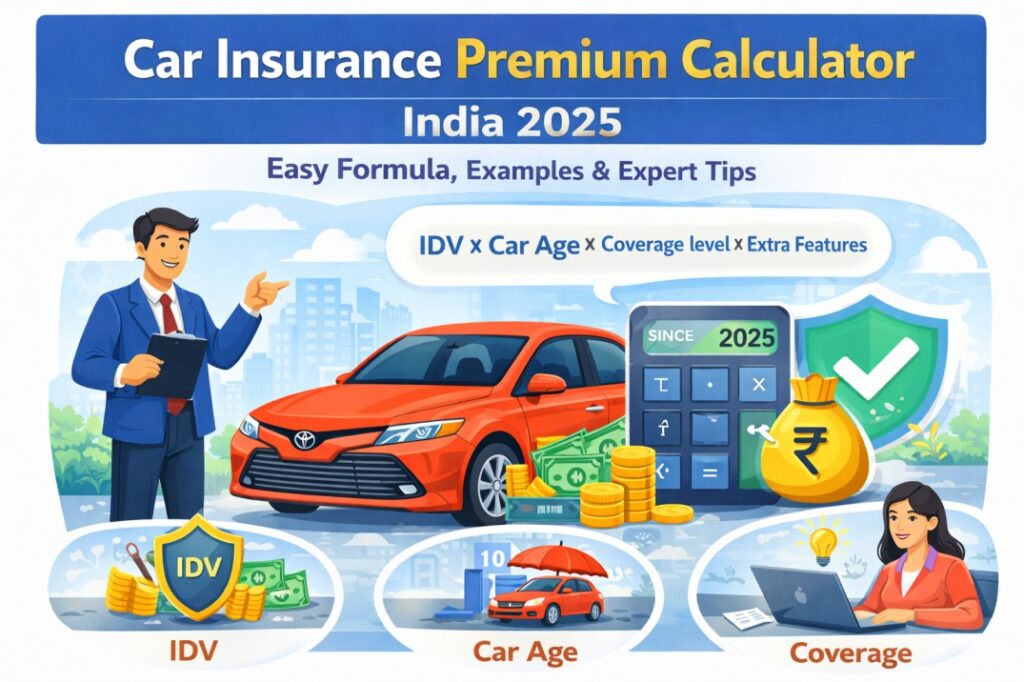
Easy Formula for Car Insurance Premium (Simplified)
Here’s a simplified version:
Premium = (IDV × OD Rate) + Third-Party Premium + Add-ons – NCB Discount
Where:
- OD Rate depends on insurer and car type
- NCB = No Claim Bonus
Example 1: Basic Calculation
Let’s assume:
- IDV: ₹6,00,000
- OD rate: 3%
- Third-party premium: ₹7,890
- NCB: 20%
- Add-ons: ₹2,000
Step 1: Calculate OD premium
₹6,00,000 × 3% = ₹18,000
Step 2: Apply NCB (20%)
₹18,000 – 20% = ₹14,400
Step 3: Add third-party premium
₹14,400 + ₹7,890 = ₹22,290
Step 4: Add add-ons
₹22,290 + ₹2,000 = ₹24,290
Step 5: Add GST (18%)
₹24,290 + GST ≈ ₹28,662 (approximate final premium)
This is how insurers calculate your total amount.
Example 2: With 50% NCB
If you have 50% No Claim Bonus:
OD premium = ₹18,000
After 50% NCB = ₹9,000
Huge difference.
This shows why understanding how no claim bonus works in car insurance is financially important.
Factors That Affect Premium in 2025
1. City of Registration
Metro cities like Mumbai, Delhi, Bengaluru usually have higher premiums due to:
- Higher traffic density
- Higher accident risk
- Expensive repair costs
2. Car Age
New cars → Higher IDV → Higher premium
Older cars → Lower IDV → Lower premium
However, very old cars may attract inspection requirements.
3. Type of Coverage
- Third-party only → Cheapest
- Comprehensive → Balanced protection
- Zero Depreciation → Higher premium but better claim payout
If you’re considering add-ons, check whether zero depreciation cover suits your car age.
4. Claim History
Even one claim can reset NCB to zero (unless protected).
More claims = Higher risk profile = Higher premium over time.
5. Add-ons Selected
Common add-ons in 2025:
- Zero Depreciation Cover
- Engine Protection
- NCB Protection
- Roadside Assistance
- Return to Invoice
Each add-on increases premium but improves coverage.
Expert Tips to Reduce Car Insurance Premium
Tip 1: Maintain High NCB
Avoid small claims when repair cost is manageable.
Over 5 years, NCB savings can be significant.
Tip 2: Choose Correct IDV
Do not blindly reduce IDV to lower premium.
Lower IDV = Lower claim payout.
Choose realistic market value.
Tip 3: Compare Policies Before Renewal
Never auto-renew without comparing.
Different insurers offer different OD rates.
You can use tools like car insurance premium calculator India 2025 to estimate before buying.
Tip 4: Install Anti-Theft Devices
Certified anti-theft devices can give small discounts.
Tip 5: Avoid Unnecessary Add-ons
Not every add-on is essential.
For example:
- Engine protection may be useful in flood-prone areas.
- Return to invoice may not be necessary for older cars.
Common Mistakes to Avoid
- Choosing lowest premium blindly
- Ignoring claim settlement ratio
- Not checking IDV properly
- Forgetting to transfer NCB
- Delaying renewal beyond grace period
Insurance should balance cost and protection.
Is Online Premium Calculation Reliable?
Yes, online calculators provide good estimates.
However, final premium may vary slightly after:
- Inspection
- Verification
- Add-on selection
Online comparison remains the smartest way in 2025.
Final Thoughts
Car insurance premium calculation is not random. It follows a structured formula based on risk, vehicle value, and driving history.
In India 2025, understanding this formula helps you:
- Save money
- Avoid underinsurance
- Protect your NCB
- Choose coverage wisely
Before renewing or buying a policy, take a few minutes to calculate, compare, and decide logically.
Smart calculation today prevents financial stress tomorrow.
FAQs
1. What is the biggest factor affecting car insurance premium in India?
IDV (Insured Declared Value) is one of the biggest factors. Higher IDV leads to higher own damage premium.
2. Can I reduce my premium legally?
Yes. Maintaining NCB, installing anti-theft devices, selecting correct IDV, and comparing insurers can help reduce premium.
3. Is third-party insurance cheaper than comprehensive?
Yes, third-party insurance is cheaper but offers limited protection. Comprehensive coverage provides broader financial protection against damages to your own car.
