Introduction
When most Indian buyers compare automatic vs manual cars, the focus is usually on price difference and driving comfort.
But here’s what actually matters more — ownership cost over time.
Because the real expense of a car is not what you pay on day one. It’s what you spend over:
- 3 years
- 5 years
- Sometimes even 10 years
And this is where many buyers get surprised.
A manual car may look cheaper initially, but an automatic may offer comfort that justifies the cost. On the other hand, automatic cars can also bring unexpected expenses if not chosen or maintained properly.
In this article, we’ll break down actual ownership costs in Indian conditions, including fuel, maintenance, repairs, and resale — in a practical, no-nonsense way.
Understanding Ownership Cost (What It Really Includes)
Ownership cost is not just EMI or car price.
It includes:
- Fuel expenses
- Service and maintenance
- Repairs and parts
- Insurance
- Depreciation (resale value loss)
If you ignore any of these, your calculation will be incomplete.
To understand basic car systems that affect these costs, you can read our guide on car engine and powertrain explained in simple terms (https://carinsighthub.com/car-engine-and-powertrain-the-complete-guide/).
Initial Cost: Automatic vs Manual
Reality in India:
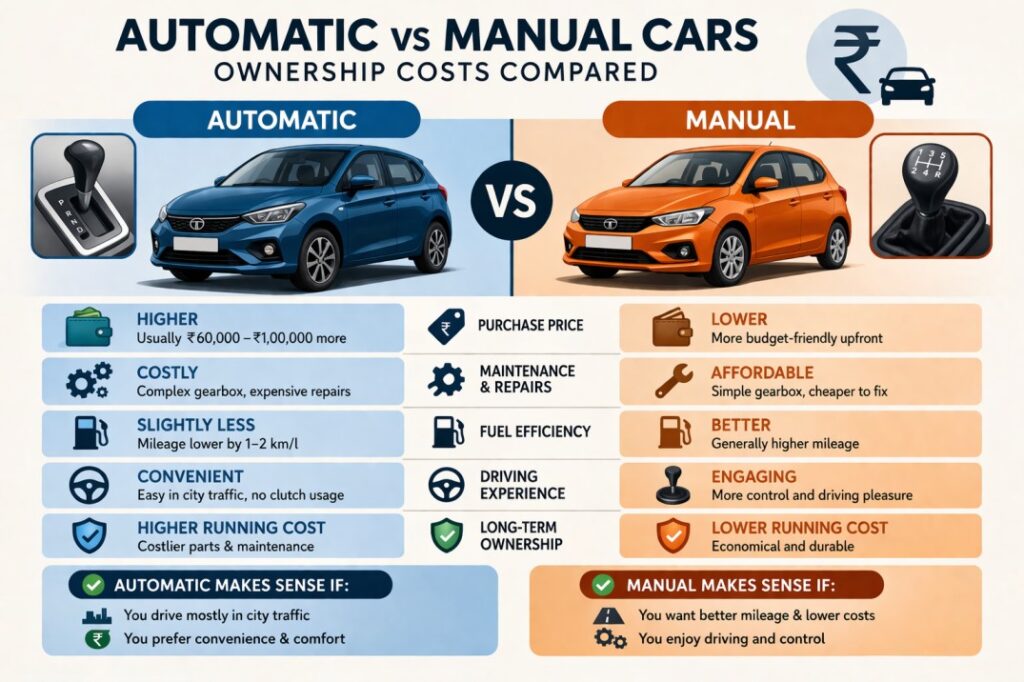
- Automatic cars cost ₹50,000 to ₹1.5 lakh more than manual variants
Why:
- Complex gearbox
- Additional components
What buyers feel:
“Automatic is expensive”
But this is just the starting point — not the full picture.
Fuel Cost Comparison
Manual Cars:
- Better mileage
- More control over gear shifts
Automatic Cars:
- Slightly lower mileage (1–3 km/l less)
- More noticeable in city traffic
Long-Term Impact:
Over 5 years:
- Manual → Saves ₹40,000–₹1 lakh (approx)
- Automatic → Higher fuel expense
If saving fuel cost is your priority, manual wins here.
Maintenance Cost Comparison
Manual:
- Simple gearbox
- Low service cost
- Easy repairs
Automatic:
- Complex system
- Needs specialised servicing
- Higher labour charges
To understand regular maintenance better, check our guide on car maintenance tips for fluids and filters (https://carinsighthub.com/car-maintenance-tips-fluids-and-filters/).
Repair Cost (Biggest Difference)
This is where the real gap appears.
Manual:
- Clutch replacement → ₹5,000–₹15,000
Automatic:
- Gearbox repair → ₹50,000 to ₹2 lakh+
Reality:
Most automatic owners don’t face this early — but when it happens, it’s expensive.
Driving Cost (Comfort vs Stress)
This is not a direct financial cost, but it matters.
Manual:
- Tiring in traffic
- More effort
Automatic:
- Relaxed driving
- Less fatigue
For daily city commuters, this “comfort value” is huge.
Resale Value Comparison
Manual:
- Wider buyer demand
- Easier resale
Automatic:
- Growing demand
- Slightly lower resale (depends on type)
In metros, automatic resale is improving.
Step-by-Step: How to Calculate Your Ownership Cost
Step 1: Estimate Your Annual Driving
- Less than 10,000 km → fuel difference less important
- More than 15,000 km → fuel cost matters more
Step 2: Calculate Fuel Expense
Multiply:
- Daily usage × fuel price × mileage
Step 3: Add Maintenance Cost
- Manual → lower
- Automatic → moderate to high
Step 4: Consider Repair Risk
- Manual → low risk
- Automatic → higher risk
Step 5: Include Comfort Value
Ask:
- How much is stress-free driving worth to you?
Comparison Table: Ownership Cost Breakdown
| Cost Factor | Automatic | Manual |
|---|---|---|
| Purchase cost | Higher | Lower |
| Fuel cost | Higher | Lower |
| Maintenance | Higher | Lower |
| Repair cost | Very high | Low |
| Driving comfort | Excellent | Low |
| Resale | Moderate | Good |
Real-Life Example (India Case Study)
Case 1: Manual Owner
Sandeep from Delhi:
- Manual hatchback
- Daily 20 km commute
After 5 years:
- Low maintenance cost
- Good mileage
- But daily fatigue in traffic
Case 2: Automatic Owner
Nikhil from Bangalore:
- Automatic hatchback
After 5 years:
- Higher fuel cost
- Slightly higher service cost
- But stress-free daily driving
Conclusion:
Manual saved money. Automatic saved effort.
Common Mistakes to Avoid
- Looking only at purchase price
- Ignoring fuel cost over time
- Not understanding repair cost
- Choosing automatic without knowing gearbox type
You can also read our guide on automatic cars people drive wrong in India to avoid costly mistakes:
https://carinsighthub.com/automatic-cars-are-easier-but-most-owners-drive-them-wrong-indian-reality-exposed/
Expert Tips (From Indian Ownership Trends)
- If your daily driving is heavy traffic → automatic is worth it
- If your budget is tight → manual is safer
- Don’t buy automatic just for trend
- Always calculate 5-year cost, not just price
If you’re still deciding, check our car buying guide that actually saves money in India (https://carinsighthub.com/read-this-before-buying-your-next-car-in-india-a-practical-guide-that-actually-saves-you-money/).
Pros and Cons Table
| Pros of Automatic | Cons of Automatic |
|---|---|
| Easy driving | Higher cost |
| Comfortable in traffic | Expensive repairs |
| Beginner-friendly | Lower mileage |
| Pros of Manual | Cons of Manual |
|---|---|
| Lower cost | Tiring in traffic |
| Better mileage | Requires effort |
| Easy maintenance | Less convenient |
Frequently Asked Questions (FAQs)
1. Which is cheaper to own — automatic or manual?
Manual cars are cheaper overall in terms of ownership cost.
2. Is automatic worth the extra cost?
Yes, if you drive daily in traffic and value comfort.
3. Do automatic cars consume more fuel?
Yes, slightly more than manual cars.
4. Are automatic cars expensive to maintain?
Regular maintenance is manageable, but repairs can be costly.
5. Which is better for beginners?
Automatic cars are easier to learn and drive.
6. Is resale better for manual cars?
Yes, but automatic demand is increasing.
7. Should I buy automatic or manual?
Choose based on your usage and budget.
Conclusion
Automatic vs manual is not just a driving preference — it’s a financial decision.
Manual cars:
- Save money
- Offer simplicity
- Lower risk
Automatic cars:
- Offer comfort
- Reduce fatigue
- Improve daily driving experience
The real winner depends on your life:
- Daily traffic, long commute → Automatic makes sense
- Budget-focused, less usage → Manual is smarter
In India, where both cost and comfort matter, the best choice is the one that balances both for your needs.
References
- Government of India Automobile Portal: https://heavyindustries.gov.in
- NITI Aayog Mobility Reports: https://www.niti.gov.in
- SIAM Reports: https://www.siam.in
- Economic Times Auto: https://auto.economictimes.indiatimes.com
- Investopedia Automobile Industry Analysis: https://www.investopedia.com/articles/investing/090915/automobile-industry.asp
