Introduction
Automatic cars have made driving in Indian cities much easier. Whether it’s Chennai traffic, Bangalore jams, or Mumbai signals, not using the clutch feels like a blessing.
But here’s the problem most owners realise too late — automatic gearboxes are expensive to repair and sensitive to driving habits.
Unlike manual cars, you cannot ignore small issues or drive carelessly. A single mistake repeated daily can reduce your gearbox life drastically. And when things go wrong, repair costs can easily cross ₹50,000 to ₹2 lakh.
The good news? Most gearbox failures in India are not due to manufacturing defects — they happen because of wrong usage, poor maintenance, and lack of awareness.
In this article, you’ll learn:
- Real reasons automatic gearboxes fail early
- Practical habits that extend gearbox life
- Mistakes most Indian drivers make daily
- Simple maintenance tips that actually work
This is not theory — this is based on real ownership patterns in India.
Understanding the Automatic Gearbox (Simple Explanation)
An automatic gearbox is a complex system made of:
- Hydraulic components
- Electronic sensors
- Clutch packs (in AMT & DCT)
- Transmission fluid
Unlike manual cars, where you control the clutch, here the system does everything automatically.
That’s why:
- It is more convenient
- But also more sensitive
If you want to understand the full working in simple terms, read our detailed guide on car engine and powertrain explained in simple terms (https://carinsighthub.com/car-engine-and-powertrain-the-complete-guide/).
Why Automatic Gearboxes Fail Early in India
Let’s be honest — Indian driving conditions are tough.
Common real-world reasons:
- Heavy traffic and constant crawling
- High temperatures (especially in cities like Chennai)
- Poor driving habits
- Skipping transmission service
- Wrong gearbox choice (e.g., DCT in heavy traffic)
Most failures are preventable if you know what to avoid.
Key Benefits of Proper Gearbox Care
If you maintain your automatic gearbox correctly, you will get:
- Longer lifespan (1.5–2 lakh km possible)
- Smooth gear shifts
- Better fuel efficiency
- Lower repair costs
- Higher resale value
Ignoring it leads to exactly the opposite.
Step-by-Step Guide to Extend Automatic Gearbox Life
Step 1: Always Stop Completely Before Changing Gear
This is the most common mistake.
Never do:
- Shift from D → R while car is moving
- Shift from R → D without stopping
This puts huge stress on internal components.
Step 2: Avoid Creeping Too Much in Traffic
In bumper-to-bumper traffic:
- Don’t keep moving inch by inch using accelerator
- Use brake and move in controlled intervals
Continuous creeping overheats the gearbox.
Step 3: Don’t Keep Car in “Drive” at Long Signals
If you are waiting for more than 30–40 seconds:
- Shift to Neutral (N)
- Keep foot on brake
This reduces load on gearbox.
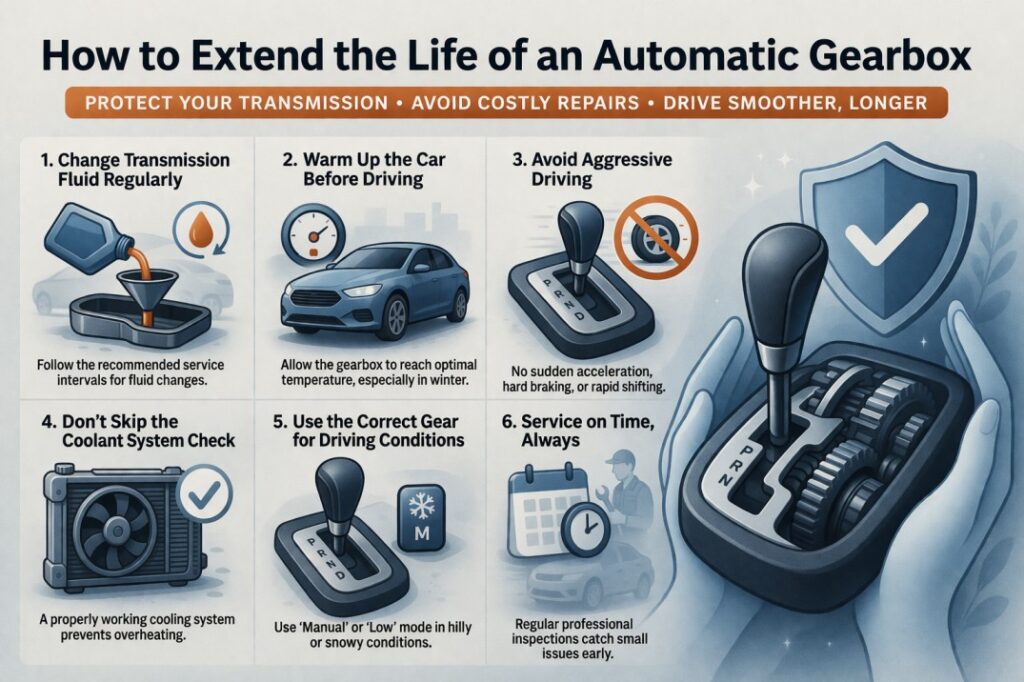
Step 4: Follow Transmission Fluid Change Strictly
Transmission fluid is critical.
- Change interval: 40,000–60,000 km (varies by car)
- Never skip this service
You can also read our guide on car maintenance tips for fluids and filters (https://carinsighthub.com/car-maintenance-tips-fluids-and-filters/) to understand why fluids matter so much.
Step 5: Avoid Aggressive Driving
Sudden acceleration and braking:
- Increase heat
- Wear internal parts faster
Smooth driving = longer gearbox life
Step 6: Choose the Right Gearbox for Your Usage
If you already own a car, this is for future buyers.
- Heavy traffic → Avoid DCT
- City driving → Prefer CVT or torque converter
- Budget → AMT
Wrong choice leads to long-term problems.
Step 7: Watch for Early Warning Signs
Never ignore:
- Jerky gear shifts
- Delay in acceleration
- Burning smell
- Warning lights
Understanding these signs early can save money. You can read more in our guide on car warning lights explained for Indian drivers (https://carinsighthub.com/real-meaning-of-car-warning-lights-a-beginners-handbook-for-indian-drivers-2025/).
Step 8: Avoid Overloading the Car
Extra weight:
- Increases stress on gearbox
- Reduces efficiency
Especially important for small automatic cars.
Comparison Table: Good vs Bad Driving Habits
| Driving Habit | Good Practice | Bad Practice |
|---|---|---|
| Gear shifting | Shift after full stop | Shift while moving |
| Traffic driving | Controlled movement | Constant creeping |
| Signal waiting | Use Neutral | Stay in Drive |
| Driving style | Smooth acceleration | Aggressive driving |
| Maintenance | Timely fluid change | Ignoring service |
Real-Life Example (Indian Case Study)
Suresh from Hyderabad bought a compact SUV with DCT gearbox.
His daily usage:
- Heavy traffic commute
- Frequent stop-go driving
Within 2 years:
- Gearbox overheating warnings
- Jerky performance
- Expensive repair estimate (~₹85,000)
Problem?
- Wrong gearbox for usage
- Constant creeping in traffic
After switching driving habits and servicing properly, performance improved — but damage had already started.
Common Mistakes to Avoid
- Treating automatic like manual
- Ignoring transmission service
- Using neutral while driving downhill
- Switching gears without stopping
- Choosing wrong gearbox type
Also read our detailed article on driving habits that secretly damage your car in India (https://carinsighthub.com/driving-habits-that-secretly-damage-your-car-in-india-most-drivers-do-these-daily/) to avoid costly mistakes.
Expert Tips (From Real Ownership Patterns)
- In traffic, patience saves your gearbox
- Avoid unnecessary acceleration
- Use handbrake on slopes instead of holding car on accelerator
- Service only at trusted workshops
- Don’t ignore small changes in driving feel
Pros and Cons of Automatic Gearbox Ownership
| Pros | Cons |
|---|---|
| Easy driving | Expensive repairs |
| Comfortable in traffic | Sensitive to misuse |
| Smooth operation | Higher maintenance cost |
| Better resale demand | Complex system |
Frequently Asked Questions (FAQs)
1. How long does an automatic gearbox last?
With proper care, it can last 1.5–2 lakh km easily.
2. Is gearbox repair very expensive?
Yes, automatic gearbox repairs are significantly costlier than manual.
3. Can bad driving habits damage gearbox?
Yes, most gearbox failures in India are due to poor driving habits.
4. How often should transmission fluid be changed?
Usually every 40,000–60,000 km, depending on the car.
5. Is it okay to keep car in Drive at signals?
For short stops yes, but for longer waits, use Neutral.
6. Which gearbox lasts longest?
Torque converter and CVT generally last longer in Indian conditions.
7. Can I drive automatic car like manual?
No, different driving style is required.
Conclusion
An automatic gearbox is one of the most expensive parts of your car — and also one of the most misunderstood.
Most problems don’t happen suddenly. They build up slowly because of:
- Daily small mistakes
- Ignoring maintenance
- Wrong driving habits
The difference between a gearbox lasting 50,000 km and 2 lakh km is not luck — it’s how you drive and maintain your car.
If you follow the simple steps shared in this article, you won’t just extend your gearbox life — you’ll also save a significant amount of money and avoid unnecessary stress.
In Indian conditions, smart driving is not optional — it’s essential.
References
- Government of India Automobile Portal: https://heavyindustries.gov.in
- NITI Aayog Mobility Reports: https://www.niti.gov.in
- SIAM Reports: https://www.siam.in
- Economic Times Auto: https://auto.economictimes.indiatimes.com
- Investopedia Automobile Industry Analysis: https://www.investopedia.com/articles/investing/090915/automobile-industry.asp
