
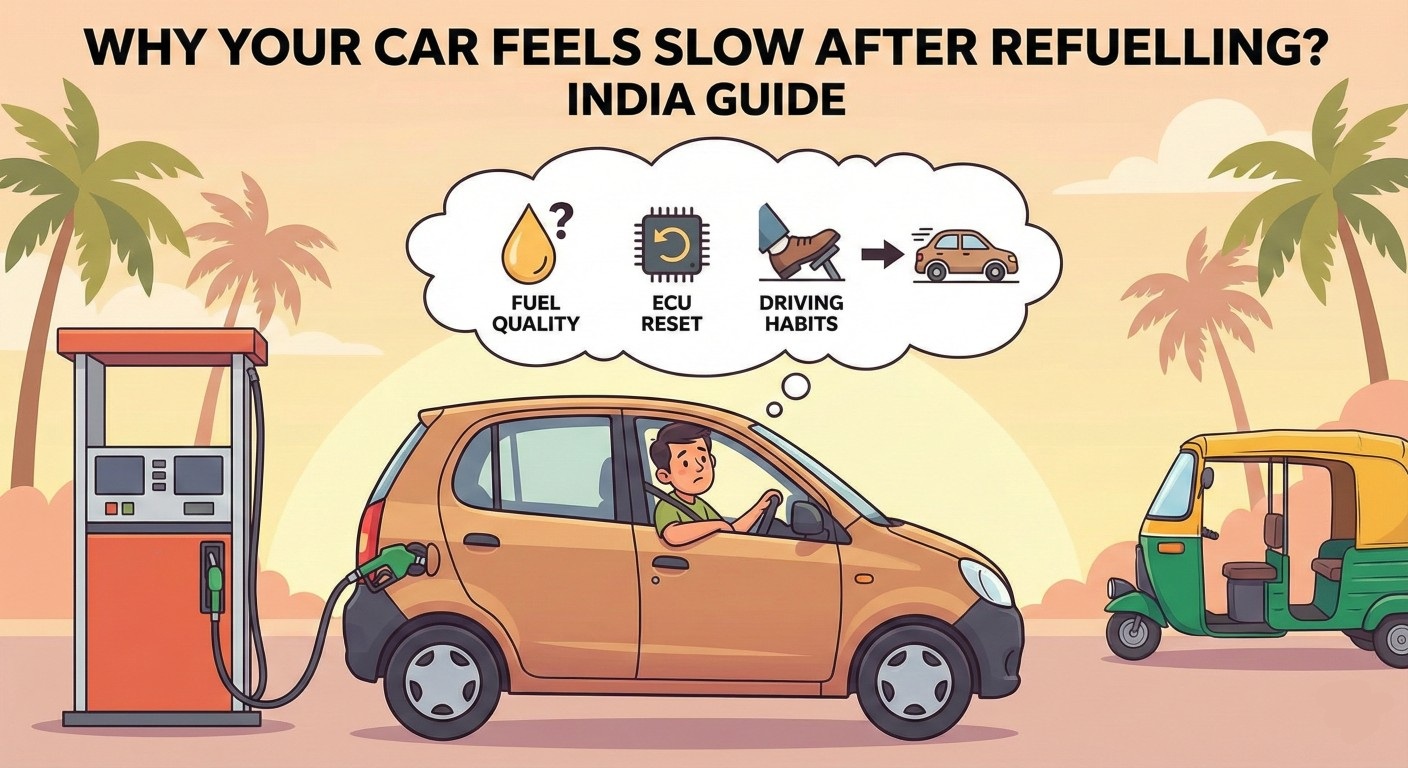
Does your car feel sluggish after refuelling? Discover the real Indian reasons – fuel quality issues, ECU learning, driving habits & mistakes. Step-by-step fixes, myths vs reality, checklist & expert tips inside.
Introduction: Full Tank… But Something Feels Wrong
You stop at a petrol pump. You pay a big amount, sometimes ₹1,500 or ₹2,500. The fuel tank is full, your wallet is lighter, and in your mind you expect the car to feel fresh and energetic.
But the moment you start driving, reality hits.
The pickup feels weak.
The throttle response is slow.
The car feels heavier than before.
Many Indian car owners experience this problem and immediately assume “engine problem aa gaya”, or worse, they feel cheated by the fuel pump.
Before you panic or rush to the service centre, understand this clearly:
👉 In most cases, a car feeling slow after refuelling is normal, temporary, and fixable.
This detailed guide explains:
- Why this happens specifically in Indian conditions
- How fuel quality affects performance
- What your car’s ECU is actually doing
- Driving habits that unknowingly make things worse
- Clear steps to fix the issue
- Real-life Indian stories you will relate to
What Does “Car Feels Slow After Refuelling” Actually Mean?
Let’s first decode the feeling.
Most owners report:
- Poor pickup for a short time
- Delayed acceleration response
- Engine feels dull or heavy
- Mileage drops temporarily
- Automatic cars feel confused with gear shifts
This does not mean:
- Engine damage
- Gearbox failure
- Major mechanical breakdown
Understanding this difference alone can save you stress and money.
Real-Life Indian Stories (Very Common, Very Real)
Story 1: Rohit’s Swift After Late-Night Refuelling (Delhi)
Rohit refuelled his Swift at 11 pm from a nearly empty roadside petrol pump. Next morning, the car struggled badly in traffic. No punch, no excitement.
He thought something was wrong with the engine.
Two days later, after refilling from a busy COCO pump, the car became normal again.
What happened: Low-quality petrol with poor combustion.
Lesson: Not all fuel pumps are equal.
Story 2: Meena’s i20 Automatic Before Highway Drive (Bengaluru)
Meena usually refuels only when the tank is low. This time, she topped up a full tank before a highway trip. The car felt lazy for the first 30–40 km.
She was worried because it’s an automatic.
What happened: ECU relearning new fuel behaviour + different driving pattern.
Lesson: Modern cars need time to adapt.
Story 3: Irfan’s Diesel SUV During Monsoon (Kerala)
After refuelling during heavy rains, Irfan noticed low power and rough engine sound. Mileage dropped sharply.
What happened: Water contamination in diesel.
Fix: Fuel filter replacement solved it.
This is closely linked to poor maintenance awareness.
You can read more here:
What Happens If You Skip Car Servicing – Real Effects After 1, 2 and 3 Delays
Story 4: Sunita’s WagonR With AC On (Pune)
Sunita felt the car was slow only after refuelling and only when AC was on.
Reality: Small petrol engine + full tank weight + AC load + quick acceleration habits.
Lesson: Sometimes it’s not fuel, it’s physics.
Story 5: Aman’s Brand-New Nexon (Psychological Effect)
Aman expected instant power boost after refuelling. When it didn’t happen, he felt something was wrong.
In reality, the car was running perfectly fine.
Lesson: Expectations often create problems that don’t exist.
Fuel Quality in India – The Biggest Hidden Reason
Fuel quality in India is not uniform, even in 2025.
Reasons:
- Ethanol blending varies by region
- Storage tanks can collect moisture
- Low-traffic pumps store fuel for longer
- Adulteration still exists in some areas
How Poor Fuel Affects Your Car
- Weak combustion
- ECU reduces engine power to protect components
- Throttle response becomes conservative
- Mileage drops temporarily
If you want a deeper understanding, read:
How Indian Fuel Quality Affects Engine Life – Petrol & Diesel Explained Simply
ECU & Sensors – Why Cars Feel “Confused” After Refuelling
Your car’s ECU (Engine Control Unit) constantly adjusts:
- Air–fuel mixture
- Ignition timing
- Throttle sensitivity
When you refuel:
- Fuel density may change
- Ethanol percentage may differ
- Combustion behaviour changes
So the ECU goes into learning mode.
This can cause:
- Slightly dull response
- Gear shift hesitation in automatics
- Temporary drop in mileage
This learning usually completes within 10 to 100 km.
Driving Habits That Make the Problem Worse
Many Indian drivers unknowingly amplify the issue.
Common habits:
- Hard acceleration immediately after refuelling
- Driving in high gear at low speed
- Overloading the car after full tank
- Switching between premium and regular fuel often
Engine lugging is a major culprit.
Read more here:
What Is Engine Lugging & Why It Damages Your Car
Temporary Issue vs Serious Problem (Comparison Table)
| Symptom | Temporary Issue | Serious Issue |
|---|---|---|
| Poor pickup | First few drives | Continues for days |
| Mileage drop | Short-term | Persistent |
| Engine sound | Slightly dull | Knocking / misfire |
| Warning lights | No | Yes |
| Fix | Normal driving | Workshop inspection |
Step-by-Step Roadmap: What You Should Do
Step 1: Stay Calm
Most cases resolve naturally.
Step 2: Drive Gently for 20–30 km
Avoid sudden acceleration.
Step 3: Observe Behaviour
Note mileage, engine sound, smoothness.
Step 4: Avoid Heavy Load Initially
Let the car settle.
Step 5: Refuel From Trusted Pumps
Consistency matters more than brand.
Step 6: If Problem Persists
Check fuel filter, air filter, spark plugs.
This is where skipped maintenance hurts.
Helpful guide:
Car Maintenance Checklist – Monthly & Yearly Guide
Myth vs Reality
| Myth | Reality |
|---|---|
| New fuel gives instant power | ECU needs time |
| Premium fuel suits all cars | Only specific engines |
| Brand problem | Mostly fuel or habits |
| Service centre is always needed | Often unnecessary |
Common Mistakes Indian Drivers Make
- Panicking and resetting ECU without reason
- Blaming engine oil immediately
- Ignoring repeated bad fuel signs
- Mixing fuel types frequently
Fuel economy confusion also adds stress.
Read:
How to Save Fuel in Daily Driving – Top 10 Practical Tips
Do vs Avoid Table
| Do | Avoid |
|---|---|
| Refuel at high-turnover pumps | Random highway pumps |
| Drive calmly after refuelling | Hard acceleration |
| Stick to one fuel type | Frequent switching |
| Follow service schedule | Skipping fuel filter |
Quick Post-Refuelling Checklist
- Smooth driving for first 30 km
- Watch mileage for 2–3 days
- Listen for unusual engine noise
- Avoid unnecessary load
- Refuel from same trusted pump next time
Pros & Cons of Modern ECU-Controlled Cars
Pros
- Better fuel efficiency
- Cleaner emissions
- Self-adjusting performance
Cons
- Sensitive to fuel quality
- Temporary sluggishness
- Needs patient driving habits
Editor’s Pick – Most Practical Advice
If your car feels slow only for a short time after refuelling and then becomes normal, relax.
If it stays slow even after 2–3 days, then investigate fuel quality and maintenance.
FAQs
1. Is it normal for cars to feel slow after refuelling?
Yes, especially modern cars with adaptive ECU systems.
2. Does ethanol-blended petrol cause this issue?
It can, especially if your car is not tuned well for higher blends.
3. Should I reset the ECU?
No, unless advised by a trained technician.
4. Can bad fuel damage my engine permanently?
Repeated exposure can cause long-term issues.
5. Does this happen more in automatic cars?
Yes, because gearboxes also adapt to driving style.
6. How long does ECU relearning take?
Anywhere between 10 to 100 km.
7. When should I visit the service centre?
If poor performance continues after the next refuel.
Final Call to Action
A slow-feeling car after refuelling doesn’t mean your car is dying.
It means your car is thinking, adapting, and protecting itself.
The more you understand fuel quality, ECU behaviour, and your own driving habits, the more confident and stress-free your ownership becomes.
👉 Bookmark this guide, share it with a worried friend, and explore more honest Indian car ownership insights on Car Insight Hub.
